
A French drain is one of the oldest and most reliable ways to move water away from where you don’t want it and once you understand how it works, you’ll see why it’s still the go-to solution for soggy Olathe yards a century and a half after it was invented. The idea is elegantly simple: water always follows the path of least resistance, so a French drain gives it an easier path than your clay soil. It’s a gravel-filled trench with a perforated pipe running along the bottom. Water sinks into the gravel, drops into the pipe, and gravity carries it away to a spot where it can do no harm. No power, no moving parts, no pump required. This guide explains exactly how that works, how deep the trench needs to be, how one is built, and importantly for our clay soil what separates a drain that lasts twenty years from one that clogs in two.
THE SHORT ANSWER
How it works: a gravel-filled trench with a perforated pipe gives water an easier path than the surrounding soil; water seeps into the gravel, enters the pipe, and gravity carries it to a lower outlet. How deep: typically 18–24 inches for a yard drain, shallower (~2 ft) for surface water, deeper for foundation/footing drains. The critical spec: at least a 1% slope about 1 inch of fall for every 8 to 10 feet or it won’t drain.
The simple physics behind a French drain
Everything a French drain does comes down to two principles: water takes the path of least resistance, and water flows downhill. That’s it.
Your yard’s problem is usually the soil. Johnson County’s heavy clay drains painfully slowly water can’t soak through it fast enough, so it sits on the surface or saturates the ground and pushes toward your foundation. A French drain fixes this by installing something water moves through far more easily than clay: a channel of loose gravel. When water reaches that gravel-filled trench, it takes the easy route down into the gravel instead of trying to force through the clay. Once in the gravel, it drops to the perforated pipe at the bottom, enters through the holes, and then the pipe’s gentle downhill slope carries it away to wherever you’ve directed it: a lower part of the yard, a dry well, or a storm outlet.
The genius is that it’s entirely passive. It uses gravity, not electricity, so there’s nothing to break down and nothing to run. A properly built French drain just quietly does its job every time it rains, for decades.
The anatomy of a French drain
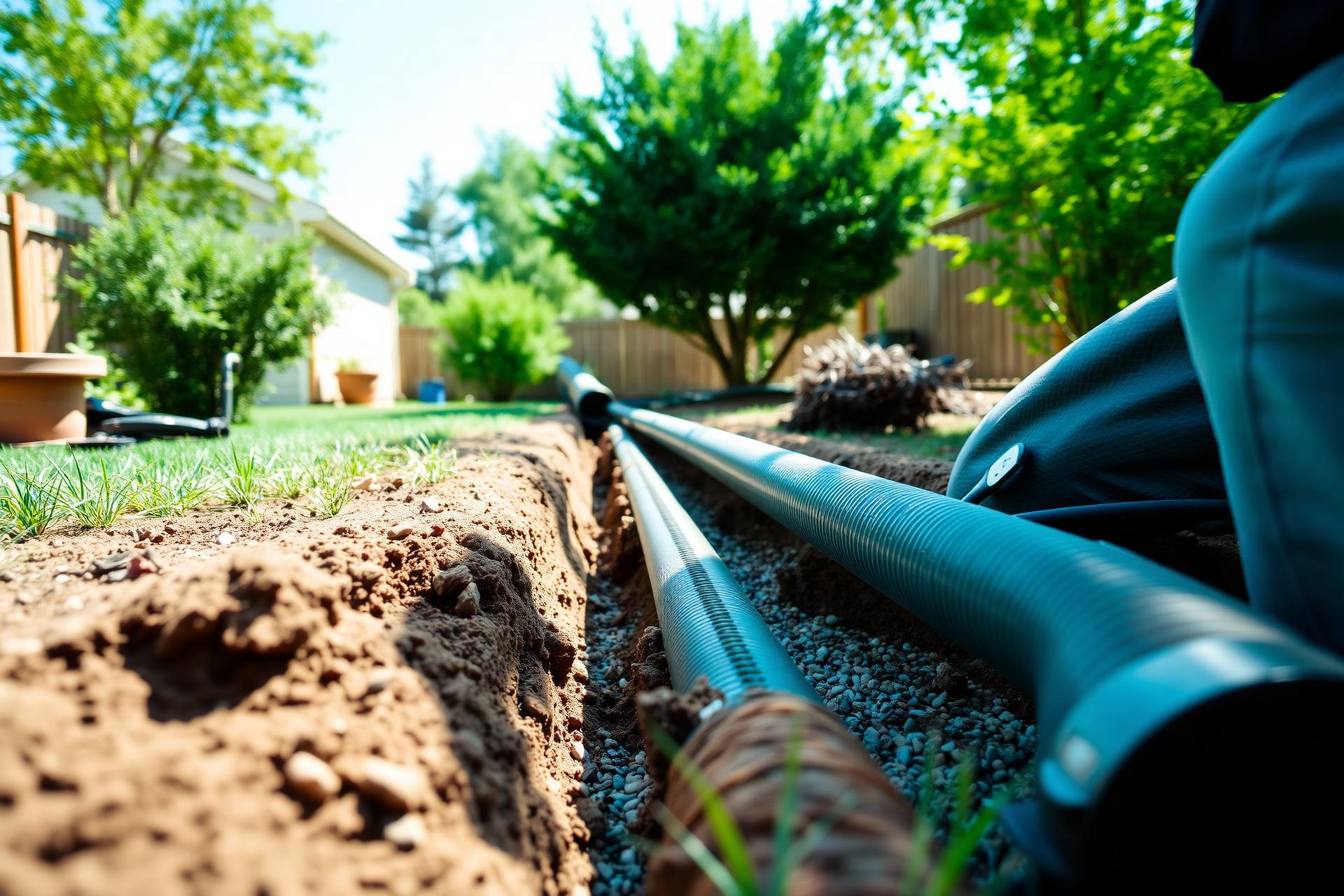
A French drain has four essential components, and each one matters skip or skimp on any of them and the system fails:
- The trench. The dug channel that holds everything, sloped continuously downhill toward the outlet. The slope is the most important part of the whole system.
- The perforated pipe. A pipe with holes or slots that let water in, running along the bottom of the trench. It’s the highway that carries collected water to the exit. In clay, a rigid perforated pipe generally outperforms flexible corrugated pipe, which can sag and hold water.
- The gravel (aggregate). Clean, washed stone surrounding the pipe. The gaps between the stones are what let water move freely down to the pipe which is why washed gravel, not fine crushed material, is essential.
- The filter fabric (geotextile). Wrapped around the gravel to keep soil and silt from washing in and clogging the system. In clay soil, this is non-negotiable skip it and the pipe silts up and stops working within a few seasons.
Some systems add an outlet feature a pop-up emitter, a dry well, or a daylight opening on a slope depending on where the water needs to go. But those four core components are the heart of every French drain.
How deep should a French drain be?
This is the question homeowners ask most, and the honest answer is: it depends on what you’re draining. Depth is matched to the job:
Drain purpose | Typical depth | Why |
|---|---|---|
Surface water / soggy lawn areas | ~2 feet | Intercepts water near the surface before it saturates the yard. |
General yard / backyard drainage | 18–24 inches | The common depth for redirecting groundwater away from problem areas. |
Foundation / footing drains | Down to the footing | Must reach the base of the foundation to relieve pressure against basement walls. |
But depth is only half the equation and not even the most important half. The single most critical measurement in any French drain is the slope. The trench must fall continuously toward the outlet at a minimum grade of about 1%, which works out to roughly 1 inch of drop for every 8 to 10 feet of length. Too little slope and the water sits in the pipe instead of moving; a reverse slope (even a slight one) sends water the wrong direction sometimes straight back toward your house. Getting this grade right over the full length of the run is exactly where careful installation earns its keep, and where most DIY and cut-rate jobs fail.
Not sure how deep or which direction your yard needs to drain? That’s a site-specific call. Get a free drainage assessment or call (913) 829-4949.
French drain vs. catch basin: know the difference
Here’s a distinction that trips up a lot of homeowners and getting it right is how you solve the problem instead of masking it. A French drain and a catch basin do different jobs:
- A French drain handles subsurface water groundwater that’s already saturated the soil. It collects water along its whole length, below ground, and is the right tool for soggy areas, seepage, and water pushing against a foundation.
- A catch basin (or surface drain) handles surface runoff the visible water that pools in a low spot or rushes off a patio during a downpour. It’s a grated box that captures water at a single point and pipes it away.
Many properties actually need both: a catch basin to grab the surface water where it collects, feeding into a piped system, and a French drain to deal with the saturated soil. The key is diagnosing which problem you actually have subsurface saturation or surface runoff because installing the wrong one is a common and expensive mistake. Understanding why properties here flood after heavy rain is the first step in figuring out which you’re dealing with.
How a French drain is built, step by step
Understanding the construction helps you judge whether a job is being done right. Here’s the process from start to finish:
1. Plan the route and the outlet
First, identify where the water is coming from and just as important where it will go. A French drain is only as good as its outlet: the water has to exit somewhere lower and harmless. Utilities are located (call 811) before any digging.
2. Dig the trench with continuous slope
The trench is excavated to the right depth and, critically, graded to fall at least 1% toward the outlet the entire way. This is checked with a level, not eyeballed the consistency of that slope over the full run is what makes the system work.
3. Line the trench with filter fabric
Woven geotextile fabric is laid into the trench with the edges left long, so it can later wrap over the top of the gravel. This barrier is what keeps clay silt out of the system the step that most determines how long the drain lasts.
4. Add a gravel base and the perforated pipe
A few inches of washed gravel go in first, then the perforated pipe is set on top, holes positioned correctly, maintaining the slope. In many designs the pipe’s holes face down, which sounds backwards but lets the pipe collect water from the water table rising into it.
5. Surround the pipe with more gravel
The pipe is buried in more washed gravel, filling most of the trench. This gravel is the collection zone the loose stone that gives water its easy path down to the pipe.
6. Wrap the fabric and backfill
The long edges of the filter fabric fold over the top of the gravel, sealing it in a permeable envelope. The trench is then topped with soil and sod, decorative river rock, or left as a gravel surface, depending on the design and where it is.
Why clay soil makes installation critical in Olathe
Everything above matters more here than in most places, because of our soil. Johnson County clay is the reason French drains are so common locally and the reason a sloppy one fails fast. Clay expands when saturated (by as much as 10%), which creates real hydrostatic pressure against foundations, and it holds water rather than letting it drain. That’s the problem a French drain solves. But clay is also full of fine particles that will silt up a poorly built system in a hurry, which is why the filter fabric and washed (not fine) gravel are absolutely essential here, and why the slope has to be right the first time clay doesn’t forgive a lazy install. This is the main reason French drains sometimes get a reputation for “not working”: almost always, the failure is the installation, not the concept.
Signs you might need a French drain
How do you know a French drain is the answer for your yard? Watch for:
- Standing water or soggy spots that linger for a day or more after rain.
- Water pooling near the foundation, or a basement that seeps or smells damp.
- Areas of the lawn that stay muddy and can’t be mowed for days.
- Mulch or soil washing out of beds, or visible erosion channels.
- A yard that slopes toward the house rather than away from it.
If several of these sound familiar, subsurface water is likely part of your problem and a French drain, possibly combined with surface drainage, is worth investigating. If you’re only seeing water at one low spot after big storms, a simpler fix might do it, which is worth an honest look before committing to a full system.
Can you build a French drain yourself?
A short, shallow French drain in an accessible yard with an obvious downhill outlet is a legitimate if strenuous DIY project for a capable homeowner. The concept is simple and the materials are available at any home center. But two things trip up most DIY attempts, and both are unforgiving:
- The slope. Maintaining a consistent 1% grade over the whole run, with no reverse pitch, is harder than it sounds and is the number-one cause of failed drains. A drain that runs slightly uphill anywhere becomes a buried puddle.
- The soil. Trenching through Johnson County clay by hand is brutal work, and clay’s fine particles punish any shortcut on filter fabric or gravel quality.
There’s also the outlet problem: figuring out where the water can actually go, legally and practically, without dumping it on a neighbor or back toward your own foundation. For a simple yard run you’re confident about, DIY away. For anything touching the foundation, involving significant depth, or where the discharge point isn’t obvious, a mistake costs more to fix than the install would have because correcting a buried, failed drain means digging the whole thing up again.
Want it done so it still works in 20 years? Get a free drainage assessment or call (913) 829-4949 we’ll diagnose the real problem and build for our clay. Curious about budget first? Here’s how much a French drain costs.
Why Olathe homeowners trust MW Lawn & Landscape
Drainage is one of those jobs where the parts you can’t see decide whether it works and after 25+ years in Johnson County clay, we build the parts you can’t see correctly:
- We diagnose before we dig. Subsurface saturation or surface runoff? French drain, catch basin, regrading, or a combination? Getting that right is the whole game, and we figure it out before quoting.
- We build for clay. Correct continuous slope, washed gravel, the right perforated pipe, and filter fabric that keeps silt out the details that decide whether your drain lasts two years or twenty.
- We plan the outlet. Every drain gets a real, legal, effective discharge point not a pipe that ends nowhere.
- We finish the yard. Drainage ties into grading, planting, and landscape enhancements and drainage solutions, so you get a working system and a landscape that looks intentional not a scar across the lawn.
- Family-owned, licensed, and insured and here for the long haul, which matters for work that’s meant to last decades.
Serving Olathe, Overland Park, and Johnson County
MW Lawn & Landscape designs and installs French drains and complete drainage solutions across Olathe, Overland Park, and the surrounding Johnson County communities. Because every yard sheds water differently, we don’t quote from a template we walk your property, find where the water is actually coming from, and build the system that solves it. If your yard turns into a swamp after every storm, there’s a fix for that, and it starts with understanding what’s really going on underground.
Frequently Asked Questions
How does a French drain work?
A French drain is a gravel-filled trench with a perforated pipe at the bottom. Because water follows the path of least resistance, it seeps into the loose gravel rather than the surrounding clay soil, drops into the pipe through its holes, and then gravity carries it along the pipe’s downhill slope to a lower outlet a low spot in the yard, a dry well, or a storm drain. It’s completely passive, using gravity with no pump or power.
How deep should a French drain be?
It depends on the job. A drain for surface water and soggy lawn areas is often about 2 feet deep, general yard drains are typically 18 to 24 inches, and foundation or footing drains must go deeper down to the base of the foundation. More important than exact depth is slope: the trench must fall at least 1%, roughly 1 inch for every 8 to 10 feet, toward the outlet, or it won’t drain.
What are the parts of a French drain?
Four essentials: a sloped trench, a perforated pipe along the bottom to carry water away, clean washed gravel surrounding the pipe so water can move freely down to it, and filter fabric (geotextile) wrapped around the gravel to keep soil and silt from clogging the system. Some designs add an outlet feature like a pop-up emitter or dry well.
Do I need filter fabric in a French drain?
In clay soil like Johnson County’s, yes it’s essential. Filter fabric keeps the fine clay particles from washing into the gravel and silting up the pipe, which is the most common cause of a French drain failing. Skipping the fabric, or using fine gravel instead of washed stone, can clog the system within a few seasons.
What’s the difference between a French drain and a catch basin?
A French drain handles subsurface water groundwater that has saturated the soil collecting it along its whole underground length. A catch basin handles surface runoff the visible water that pools in low spots or rushes off hard surfaces capturing it at a single grated point. Many yards need both. Diagnosing which problem you have is essential to fixing it.
Why do French drains fail?
Almost always because of installation, not the concept. The most common failures are insufficient or reversed slope (so water sits or runs the wrong way), missing filter fabric (so clay silt clogs the pipe), fine gravel instead of washed stone, or no proper outlet so the water has nowhere to go. In clay soil, these mistakes show up fast.
Can I install a French drain myself?
A short, shallow drain in an accessible yard with a clear downhill outlet is a realistic DIY project if you’re prepared for hard digging. The hard parts are maintaining a consistent 1% slope over the whole run and figuring out a proper discharge point. Anything near the foundation, deep, or with an unclear outlet is better left to a professional, since fixing a failed buried drain means digging it all up again.
How long does a French drain last?
A properly installed French drain correct slope, washed gravel, quality perforated pipe, and filter fabric can last 20 years or more. Because it has no moving parts, it doesn’t wear out so much as clog, and good installation with the right materials is what prevents that. Occasional cleanouts can extend its life further.
Does a French drain need a slope?
Yes it’s the single most important requirement. The trench and pipe must fall continuously toward the outlet at a minimum of about 1% grade, roughly 1 inch of drop per 8 to 10 feet. Without adequate slope, water stagnates in the pipe; with a reverse slope, it can flow back toward your house. Getting this grade right over the full length is critical.
Will a French drain fix water in my basement?
It can, if the water is coming from saturated soil pushing against your foundation an exterior footing drain relieves that pressure, and an interior perimeter drain collects water that gets in and routes it to a sump pump. But basement water can have several causes, so the right fix depends on diagnosing the source. It’s worth a professional assessment before committing to a system.