
If water pools in your yard after every Kansas thunderstorm, or your basement smells damp every spring, you’ve probably already typed “French drain” into Google and found prices ranging from $500 to $18,000, which tells you almost nothing. Here’s the useful version. In 2026, most Olathe homeowners spend $3,000 to $8,000 on a professionally installed French drain, though a simple yard drain can run well under that and a full interior basement system well over it. The spread is huge because “French drain” describes several very different projects and because our Johnson County clay soil is one of the biggest cost variables there is. This guide breaks down real 2026 pricing by type, explains what drives your number up or down, and honestly tells you when you might not need one at all.
THE SHORT ANSWER
Typical Olathe project: $3,000–$8,000. Per linear foot: $10–$35 for an exterior yard drain, $30–$90 for a deep perimeter drain, $40–$100 for an interior basement system. A 100-foot yard drain: roughly $2,800–$6,500. Add a sump pump: $600–$2,600 more. Biggest local cost driver: Johnson County’s heavy clay and any rock or obstructions in the trench line.
Why French drains are so common in Olathe
Johnson County sits on heavy clay soil, and clay is terrible at draining. Sandy soil lets rainwater filter down and away; clay holds it like a bowl. That’s why after a heavy Kansas storm you get standing water that lingers for days, soggy low spots that never dry out, and water finding its way against foundations instead of soaking into the ground.
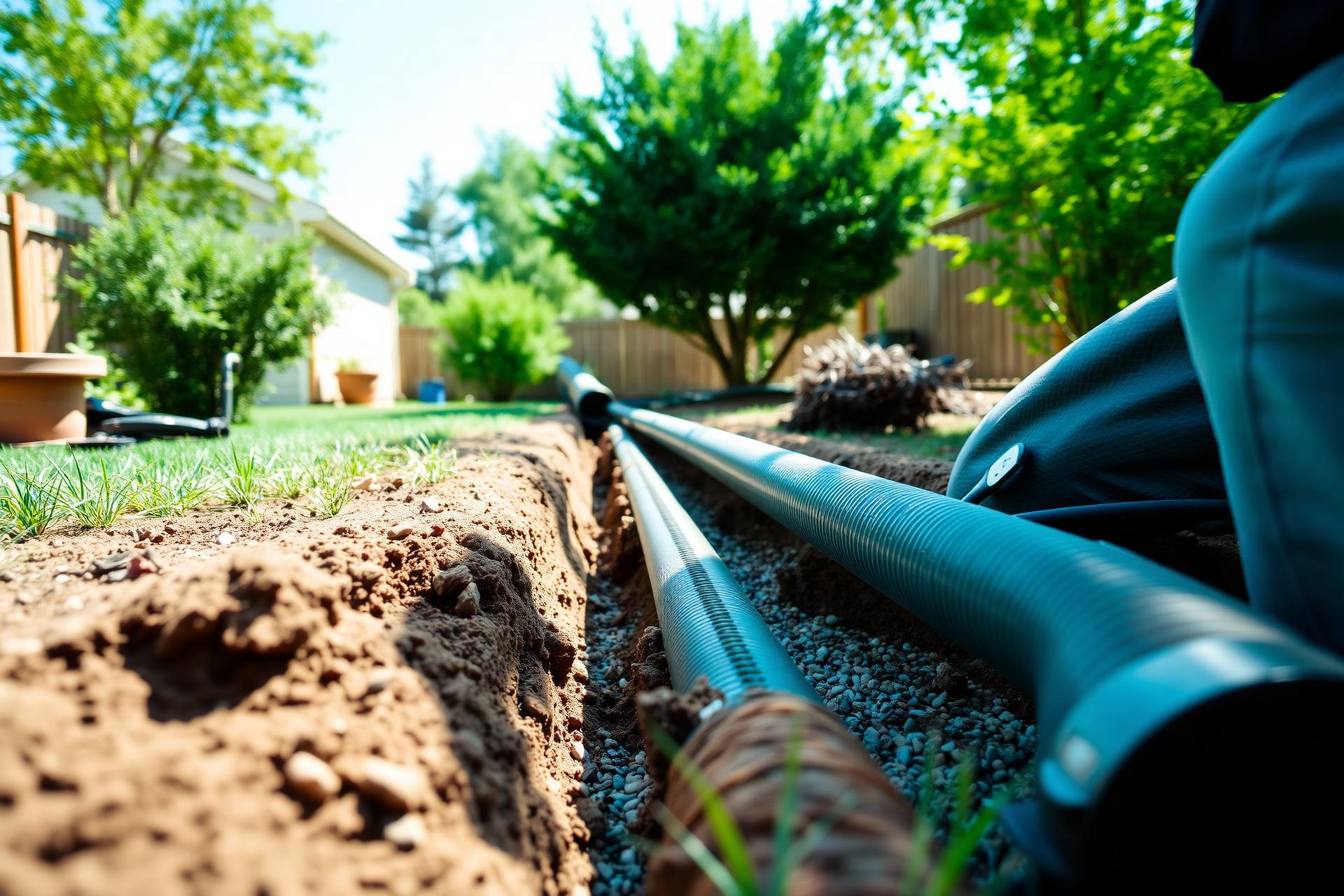
A French drain solves this by giving water an easier path than the clay. It’s a gravel-filled trench with a perforated pipe at the bottom: water takes the path of least resistance into the gravel, drops into the pipe, and gets carried somewhere harmless a lower part of the yard, a dry well, or a storm outlet. The concept is about 150 years old and it still outperforms most modern alternatives, because it works with gravity rather than fighting it. It’s the same reason why properties here need drainage solutions after heavy rain is such a recurring conversation in this metro.
The catch and this matters for your budget is that the same clay that creates the problem also makes the trench harder to dig, which is exactly why local pricing tends to sit at the higher end of national ranges.
French drain cost by type (2026)
The single biggest factor in your price is which type of drain you actually need. These are genuinely different projects with different price tags:
Type of French drain | Cost per linear foot | Typical total project | What it does |
|---|---|---|---|
Curtain drain (shallow, ~2 ft) | $10 – $25 | $1,000 – $5,000 | Diverts surface water rain and roof runoff away from the house. |
Yard / trench drain (exterior) | $10 – $35 | $2,800 – $6,500 (100 ft) | Dries out soggy lawn areas and low spots that hold water. |
Deep exterior perimeter drain | $30 – $90 | $2,000 – $10,000 | Handles groundwater at the foundation; requires deep excavation. |
Interior basement perimeter | $40 – $100 | $4,000 – $12,000+ | Collects water seeping into the basement; needs concrete cutting + sump pump. |
Crawl space drain | — | $2,000 – $8,000 | Perimeter drain sloped to a sump pump under the house. |
Notice the pattern: the further you go from a simple yard trench, the steeper the price and interior systems are the most expensive of all, because they require saw-cutting your basement floor, hand-excavating beneath the slab, installing the system, and pouring new concrete over it. That’s days of labor inside an occupied home, not an afternoon with an excavator.
Add-on costs to budget for
Add-on | Typical 2026 cost | When you need it |
|---|---|---|
Sump pump | $600 – $2,600 | Required for most interior systems; needed outside when gravity alone won’t move water away. |
Sump pump + drain combined | $50 – $100 per ft | Common pricing when the two are installed together. |
Battery backup for sump pump | Varies | Highly recommended storms cause both the water and the power outage. |
Sod / landscape restoration | $0.30 – $0.80 per sq ft | Trenching disturbs turf; budget for repair. |
Foundation waterproofing membrane | $5 – $12 per ft (while wall is exposed) | Add it during excavation doing it later costs $30–$50 per ft. |
That last row is the most valuable line in this guide. If a crew is already excavating down to your footing, adding a waterproofing membrane costs a fraction of what it would to dig the same trench again in three years. Same excavation, double the protection always ask about it while the wall is open.
Not sure which type your property actually needs? That’s the whole ballgame on price. Get a free drainage assessment or call (913) 829-4949 we’ll tell you straight.
What drives your price up or down
Two houses on the same Olathe street can get quotes thousands of dollars apart. Here’s what accounts for that:
- Length of the run. Pricing is largely per linear foot, so a 40-foot problem area costs a fraction of a 120-foot perimeter.
- Depth. A shallow curtain drain at two feet is a different job from a footing drain going down several feet. Depth multiplies excavation time.
- Soil and site conditions the big one locally. Clay, rock, and buried obstructions are the single biggest variable within any drain type. Our clay digs slow and heavy, which is a real cost, not a markup.
- Access. If a machine can reach the trench line, you save significantly. If everything must be hand-dug around a deck, mature trees, a patio, or tight side yards, labor climbs fast.
- Obstacles crossed. Driveways, sidewalks, and patios in the path mean cutting and restoring hardscape.
- Where the water goes. A drain is only as good as its outlet. If there’s a natural low point to daylight into, great. If not, you may need a dry well or a pump both add cost.
- Restoration. Sod, plantings, and mulch replacement after trenching. It’s real money, and honest quotes include it rather than leaving you with a scar across the yard.
- Utilities and permits. Lines must be located before digging, and some situations require permits or affect drainage onto neighboring property.
Are French drains worth it? (An honest answer)
Here’s the part most pricing guides skip, because they’re selling you something. Sometimes the answer is no or at least, not yet.
A French drain is absolutely worth it when you have a genuine, persistent water problem: standing water that sits for days, a basement that seeps or floods, water pooling against the foundation, a yard you can’t use for weeks after a storm, or soil movement threatening the house. In those cases, a properly built drain is one of the highest-return investments you can make on a property because water damage compounds. Foundation repair costs vastly more than drainage, and untreated moisture leads to mold, ruined finishes, and structural problems. It also protects resale value, since a documented wet basement is a negotiating hammer for every future buyer.
But if your issue is minor a small damp patch, water near a downspout, a low spot that dries out in a day there may be a cheaper fix that works just as well:
- Gutter and downspout extensions. Astonishingly often, the “drainage problem” is roof water dumping right at the foundation. Extending downspouts 6–10 feet away costs very little and solves a surprising number of complaints.
- Regrading. If the ground slopes toward the house, correcting the grade so it falls away can fix the issue without a trench.
- Downspout burial to a pop-up emitter. A middle option carries roof water away underground without a full perimeter system.
- Soil amendment and planting. For a mildly soggy area, improving the soil and using water-tolerant plants can be enough.
Any contractor who won’t discuss these before quoting a five-figure system isn’t diagnosing your problem they’re selling a product. We’d rather tell you your downspouts are the issue and keep your business for the next twenty years than sell you a drain you didn’t need.
The mistake that makes drainage worse
This is worth understanding before you hire anyone, DIY or otherwise: a French drain built wrong doesn’t just underperform it can actively make things worse. Get the slope wrong and you’ve built a gravel channel that collects water and delivers it straight to your foundation. Skip the filter fabric and the pipe silts up with clay and quits working in a few seasons. Point the outlet nowhere and the trench becomes an underground pond. Use the wrong pipe or wrap it in the wrong sock for clay soil and it clogs.
The physics here are unforgiving, and clay is the least forgiving soil to work in. This is the main reason French drains have a reputation for “not working” most of the failures are installation failures, not design failures.
DIY vs. professional installation
DIY can genuinely save 40 to 60 percent on labor, which is real money on a $5,000 project. It’s also the reason a lot of homeowners end up paying twice. Here’s the honest comparison:
Factor | DIY | Professional installation |
|---|---|---|
Savings | Save 40–60% on labor material cost stays | No labor savings, but no rework either |
The digging | Trenching clay by hand is brutal; rental trencher struggles in it | Machine excavation sized to the job and the soil |
Slope precision | Must maintain consistent fall the #1 failure point | Laser/level-set grade the water actually follows |
Materials | Easy to buy the wrong pipe, fabric, or stone for clay | Correct pipe, filter fabric, and washed stone spec’d for our soil |
Utilities | You are liable for what you hit | Lines located, insured crew, permits handled |
Outlet & discharge | Often the forgotten step and the one that ruins it | Planned discharge point, dry well, or pump |
If it fails | Dig it up and start over twice the cost | Standing behind the work |
The realistic take: a short, shallow curtain drain in an accessible yard with clear fall to a low spot is a legitimate DIY weekend for a capable homeowner. Anything involving your foundation, a basement, significant depth, or an unclear discharge point is where a mistake costs more than the labor you saved.
Want a real number instead of a range? Get a free drainage assessment or call (913) 829-4949 we’ll walk your property and quote the actual fix.
Save money by combining work
Drainage is disruptive which makes it the perfect time to handle anything else that requires digging or would be damaged anyway. Homeowners routinely save by bundling:
- Waterproofing while the foundation wall is exposed $5–$12 per foot now versus $30–$50 per foot to re-excavate later.
- Landscape work in the disturbed area since the beds are getting torn up regardless, it’s the natural moment for a properly planned landscape design or landscape enhancements and installationrather than paying twice.
- Irrigation adjustments while lines are exposed far cheaper than a separate trenching visit.
- Bed and turf restoration restoring the beds and mulch afterward as part of the same project leaves the yard finished, not scarred.
One mobilization, one crew, one disruption. That’s where the real savings hide on a drainage project not in shaving the per-foot rate.
How to compare French drain quotes
When you collect bids, the cheapest number is rarely the cheapest project. Ask every contractor:
- Where exactly does the water discharge to? (If they can’t answer clearly, walk away.)
- What pipe, stone, and filter fabric are you using and why that spec for clay soil?
- What slope are you cutting, and how do you verify it?
- Is restoration sod, beds, mulch included in this price or extra?
- Are utility locates, permits, and insurance covered?
- What’s the warranty, and what specifically does it cover?
A bid that’s dramatically lower than the others is usually missing one of those most often the discharge plan or the restoration. That’s not a discount; it’s a bill you’ll get later.
Why Olathe homeowners choose MW Lawn & Landscape
We’ve spent 25+ years working in Johnson County’s clay, which is exactly the experience a drainage project demands:
- We diagnose before we quote. Sometimes the answer is a French drain. Sometimes it’s a downspout extension and a grade correction and we’ll tell you that, even though it’s the smaller invoice.
- We build for clay. Correct slope, the right pipe and filter fabric for our soil, washed stone, and a real discharge plan the details that decide whether a drain still works in ten years.
- We leave the yard finished. Restoration is part of the plan, not an afterthought. You get a working drain and a landscape that looks intentional.
- One team for the whole property. Drainage ties into grading, planting, irrigation, and ongoing landscape maintenance so it’s coordinated rather than bolted on.
- Family-owned, licensed, and insured. Local accountability from a company that will still be here when you need us again.
Serving Olathe, Overland Park, and Johnson County
MW Lawn & Landscape designs and installs French drains and complete drainage solutions across Olathe, Overland Park, and the surrounding Johnson County communities. Every property drains differently so rather than quoting from a price list, we’ll walk your yard, find where the water is actually coming from, and give you a straight number for the fix you actually need.
Frequently Asked Questions
How much does it cost to install a French drain?
In 2026, most homeowners spend $3,000 to $8,000 for a professionally installed French drain, with the full range running from about $500 for a simple short run to $18,000 for a complex basement system. Per linear foot, expect roughly $10 to $35 for an exterior yard drain, $30 to $90 for a deep perimeter drain, and $40 to $100 for an interior basement system. Your exact price depends on length, depth, soil, access, and where the water discharges.
How much does a French drain cost per linear foot in Olathe?
Exterior yard and curtain drains typically run $10 to $35 per linear foot, deep exterior perimeter drains $30 to $90, and interior basement systems $40 to $100. Olathe pricing tends toward the higher end of each range because Johnson County’s heavy clay soil is slower and harder to excavate than sandy soils.
Are French drains worth it?
They’re absolutely worth it if you have a real water problem standing water that lingers, a seeping basement, or water pooling against your foundation because water damage compounds and foundation repair costs far more than drainage. But if the issue is minor, a downspout extension or a grade correction may solve it for a fraction of the price. A good contractor will tell you which situation you’re in before quoting.
Why are French drains more expensive in Kansas City’s clay soil?
Soil condition is the single biggest cost variable within any drain type. Clay is dense, heavy, and slow to excavate, which increases labor time. It also demands the right pipe and filter fabric spec, since clay silt will clog a poorly specified system. The same clay that makes drains necessary here makes them cost more to install correctly.
Does a French drain need a sump pump?
Interior basement systems almost always do, because the water has to be lifted out and moved away. Exterior drains only need one when gravity can’t carry water to a suitable discharge point. Adding a sump pump costs about $600 to $2,600, and a battery backup is worth considering the storm that floods your basement is often the same one that takes out the power.
How long does a French drain take to install?
A shallow exterior drain in an accessible yard can often be done in a day. Deep exterior perimeter systems typically take several days because of the excavation involved. Interior basement systems take the longest, since the concrete has to be saw-cut, the trench hand-dug beneath the slab, the system installed, and new concrete poured and cured.
Can I install a French drain myself?
DIY can save 40 to 60 percent on labor, and a short, shallow curtain drain in an accessible yard with a clear low point to drain toward is a realistic project for a capable homeowner. The risk is that a French drain built wrong can make drainage worse incorrect slope, missing filter fabric, or no real discharge point are common failures. Anything near your foundation or basement is worth hiring out.
What’s the difference between a curtain drain and a French drain?
A curtain drain is a shallower version, installed about two feet deep, that intercepts surface water like rain and roof runoff before it reaches your house. A deep French drain goes further down and handles groundwater as well. Curtain drains are the cheaper option at roughly $10 to $25 per linear foot; deep drains cost more but solve bigger problems.
Will a French drain damage my landscaping?
Trenching does disturb turf and beds, so restoration should be part of the project. Sod replacement runs about $0.30 to $0.80 per square foot, and beds may need re-mulching. Make sure your quote states whether restoration is included a bid that excludes it isn’t cheaper, it just moves the cost to later.
How long does a French drain last?
A properly installed French drain with the correct pipe, washed stone, filter fabric, and slope can last decades. Failures are usually installation failures rather than the system wearing out most commonly silt clogging a poorly specified pipe, or an inadequate slope and discharge point. That’s why the spec and the installer matter more than the brand of pipe.