
Every fall, Overland Park homeowners shut the water off to their sprinkler system, assume it will drain on its own, and head into winter without another thought. Come April, a cracked backflow preventer or a split mainline tells them otherwise. If you have an in-ground irrigation system in the Kansas City metro, winterizing it is the one piece of fall maintenance that protects thousands of dollars of buried pipe, valves, and components and the part most people get wrong is thinking they can just turn it off and let it drain. In our climate, draining isn’t enough. The only reliable way to clear the water is a compressed-air blowout, which is exactly what professional sprinkler winterization in Olathe is built to do.
Here’s what winterization actually involves, why the blowout matters so much in Kansas, when to schedule it before the first hard freeze, and what it costs versus what a cracked line costs to repair in spring.
THE SHORT ANSWER Sprinkler winterization means clearing every drop of water out of your irrigation system before it freezes. In Kansas City, simply draining the system leaves water trapped in low points, heads, valves, and the backflow device so a professional uses a high-volume air compressor to blow out each zone. The window is mid-October to early November; aim to have it done before the first hard freeze, which can arrive before Thanksgiving. A blowout costs a small fraction of repairing a cracked pipe, valve, or backflow preventer. |
What Sprinkler Winterization Actually Is
Winterization is the process of removing all water from your irrigation system so nothing is left inside to freeze. A complete job covers more than the pipes in the yard. It includes the mainline, every zone of lateral piping, all the sprinkler heads, the control valves, the backflow prevention assembly, and any drip or micro-spray lines feeding your beds. We shut off the water supply at the source, switch the controller to its off or “rain” setting so it doesn’t try to run a dry system over winter, and clear each zone with compressed air.
That last step is the whole point. You can shut a valve and open a drain, but gravity alone will never pull water out of a head sitting at the high end of a run or out of a pipe that dips below the drain point. Those trapped pockets are where freeze damage starts.
Why Draining Isn’t Enough in Kansas
Irrigation pipe is laid to follow the grade of your yard, which means it rises and falls. Manual and auto-drain valves only remove water that can flow downhill to them any pipe that runs uphill from a drain, every sprinkler head, and the backflow assembly above ground all hold water the drains can’t reach. When that water freezes, it expands by roughly nine percent. In a sealed pipe or a brass valve body, that expansion has nowhere to go, so it splits the component open.
Kansas City makes this worse than milder climates for two reasons. First, our freeze-thaw swings are sharp a 70-degree afternoon can drop below freezing overnight in late October, and that repeated expansion-and-contraction works cracks wider. Second, the backflow preventer, the single most expensive component on most systems, sits above ground where it’s fully exposed to the cold. A compressed-air blowout is the only method that pushes water out of those high points and out of the backflow device before the cold gets to them.
THE RULE OF THUMB If you can’t guarantee every head, every uphill run, and the backflow assembly are bone-dry, the system isn’t winterized it’s just turned off. Those are two very different things when the temperature drops. |
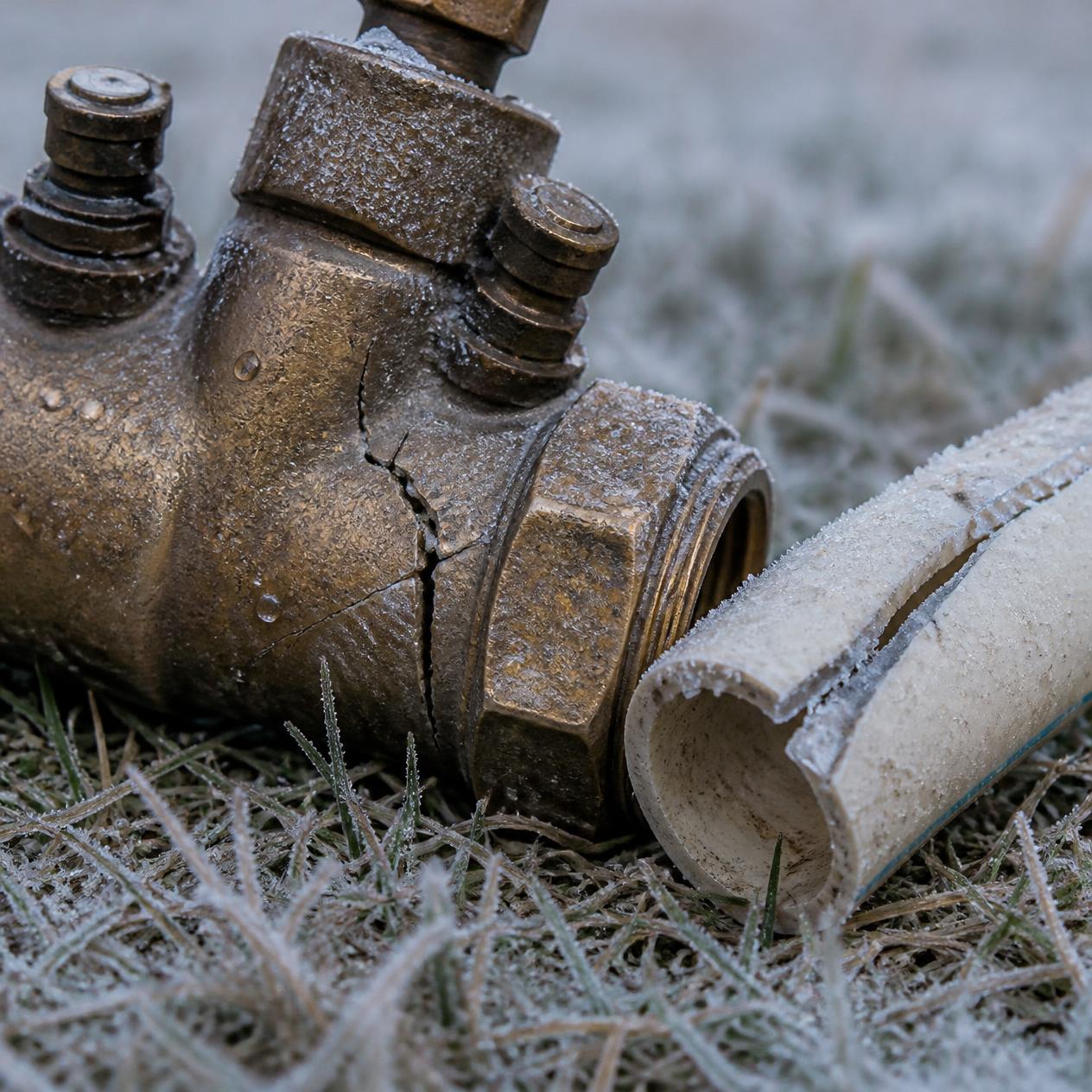
What Freeze Damage Actually Costs
The reason winterization is worth scheduling every single year is simple math: the blowout is cheap and the repairs are not. Here’s what typically fails when a system freezes with water still in it, and why each one hurts.
| Component | What happens when it freezes | Why it’s costly |
|---|---|---|
| Backflow preventer | Brass body and internal checks crack; the unit splits | The priciest single part on the system; replacement plus labor is the worst-case bill |
| Mainline & lateral pipe | PVC or poly pipe cracks underground along the freeze point | Requires locating the break and excavating the yard to reach it |
| Control valves | Valve bodies and solenoids split or seize | Each affected zone needs the valve dug up and replaced |
| Sprinkler heads | Internal seals and risers crack; heads won’t retract or seal | Multiple heads often fail at once across exposed zones |
| Fittings & manifold | Joints separate, causing leaks that surface in spring | Hard to spot until start-up; can waste water for weeks |
None of this shows up in November. It surfaces in spring, the first time you pressurize the system which is why a buried freeze crack is one of the most common things we find on an irrigation repair [/irrigation-repair-olathe-ks/] call in April. A single season skipped can undo years of saving on a seasonal blowout.
| Beat the freeze book your blowout now. MW Lawn clears your full system with a high-volume commercial compressor every zone, head, valve, and the backflow device backed by a winter-damage guarantee. Schedule sprinkler winterization or call (913) 829-4949. |
When to Winterize Your Sprinklers in Kansas City
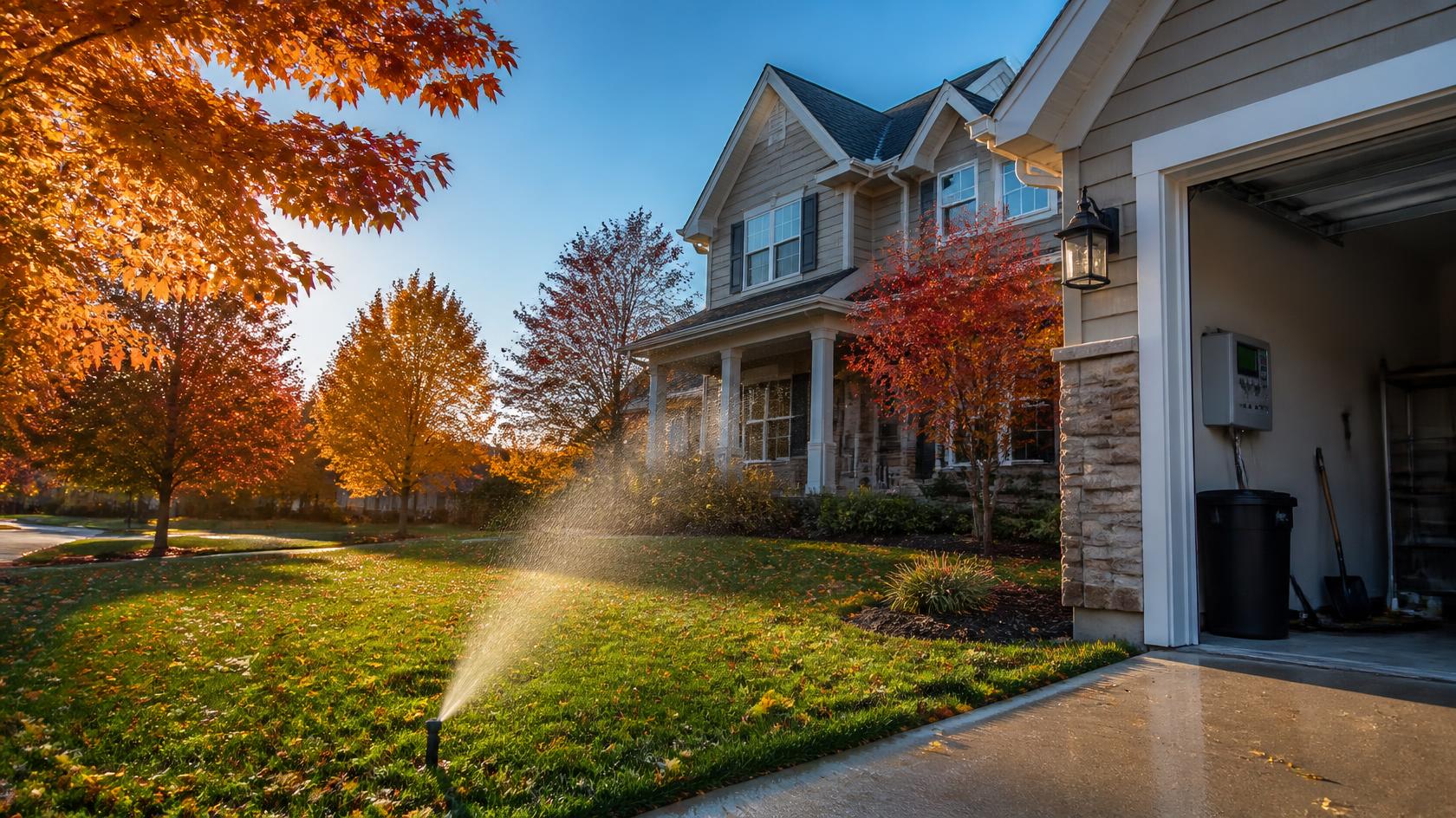
Timing is a balance. Winterize too early and you give up weeks of fall watering your lawn still needs fall is when cool-season fescue and bluegrass do most of their root growth. Wait too long and you’re gambling against a hard freeze. Here’s the window for the KC metro:
- First frost: the metro’s average first frost lands in mid-October (roughly the 10th–20th). A light frost won’t damage a system, but it’s the signal the hard freeze is coming.
- The scheduling window: mid-October to early November is the sweet spot. It lets your lawn keep drinking through the warm fall stretch while still clearing the system with margin to spare.
- The hard deadline: have the blowout done before the first hard freeze (a sustained drop to around 28°F or below). In Kansas City that can arrive before Thanksgiving some years earlier. Don’t wait for the forecast to force the issue; book ahead.
The practical move is to schedule in early October for a service date in the back half of the month. Reputable crews book up fast once the first cold snap hits the forecast, and you don’t want to be calling around the week a freeze is predicted.
DIY vs. Professional Blowout: Why the Compressor Matters
It’s fair to ask whether you can rent a compressor and do this yourself. You can and every year, homeowners damage their own systems trying. The problem isn’t the concept, it’s the equipment and the pressure.
A blowout isn’t about high pressure; it’s about high volume moving enough air (CFM) to physically push water through a full zone. A typical homeowner shop compressor holds plenty of pressure but can’t move anywhere near the volume needed, so it either does nothing or tempts you to crank the PSI up to compensate. That’s where heads get destroyed: too much pressure blows out seals, cracks heads, and can damage the very parts you’re trying to protect. Residential systems should be cleared at low pressure generally well under 80 PSI for rigid pipe and lower still for poly using a high-volume commercial compressor, zone by zone.
| Factor | DIY attempt | Professional blowout |
|---|---|---|
| Equipment | Small shop compressor high PSI, low CFM | High-volume commercial compressor sized for irrigation |
| Main risk | Too much pressure cracks heads, seals & valves | Correct low-pressure, high-volume clearing per zone |
| Backflow device | Often missed or under-cleared | Explicitly cleared and shut down |
| If something’s wrong | You find out at spring start-up | Problems flagged on the spot for repair |
| Guarantee | None damage is on you | Backed by a winter-damage guarantee |
For a task you do once a year on a system worth several thousand dollars, the professional blowout is cheap insurance done right.
What a Professional Winterization Includes
When MW Lawn winterizes your system, it’s a complete shutdown, not a quick pass with a compressor. A proper service covers:
- Shutting off the water supply to the irrigation system at the source so no new water can enter the lines.
- Blowing out every zone with a high-volume commercial air compressor one zone at a time at safe pressure until the heads run dry.
- Clearing the backflow assembly, valves, heads, and drip lines the high points and exposed components gravity drains can’t reach.
- Shutting down the controller so it doesn’t attempt to run the dry system through the winter.
- A quick system check while everything’s exposed any worn head, weeping valve, or backflow issue gets flagged before it becomes a spring surprise.
That last point is quietly one of the biggest benefits. A blowout is the one time of year every zone runs under observation, so it’s the natural moment to catch the small problems before they overwinter into bigger ones.
While the System Is Down: Finish the Fall Lawn Work
The same mid-October-to-early-November window that’s ideal for winterization is also the tail end of the best stretch all year for lawn renovation in Kansas City. If your fescue thinned out over the summer, this is the season it recovers and the two jobs pair naturally because the crew is already on your property.
Fall is when cool-season grass puts its energy into roots, so fall aeration and overseeding done now establishes new grass before dormancy and gives you a thicker, more freeze-tolerant lawn next spring. Knocking out the overseeding and the winterization in the same visit is the efficient way to close out the lawn-care year one trip, both jobs, nothing left exposed to the cold.
| Pair your blowout with fall overseeding. One visit, both jobs done right before winter. Request a free quote or call (913) 829-4949 to get on the winterization schedule. |
Why Overland Park Homeowners Choose MW Lawn & Landscape
Winterization is a small job that protects a big investment, so it’s worth having a crew that does it right the first time:
- 25+ years in Johnson County. We’ve winterized systems through enough Kansas freeze-thaw cycles to know exactly where water hides and what fails first.
- Commercial-grade equipment. A high-volume compressor sized for irrigation not an undersized rental that leaves water behind or forces risky pressure.
- Winter-damage guarantee. We stand behind the blowout. If we winterize it, it’s protected.
- A full irrigation team. Spring start-up, backflow testing, repairs, and seasonal maintenance the same crew that shuts your system down in the fall brings it back online in the spring.
- One local team, all year. Irrigation, fertilization, aeration, cleanup we handle the lawn end to end, so you’re not juggling four vendors.
Family-owned, licensed, and insured, serving Overland Park and Johnson County since 2000.
Serving Overland Park, Lenexa, Olathe, and Johnson County
MW Lawn & Landscape provides sprinkler winterization and full irrigation service across Overland Park, Lenexa, Olathe, and the surrounding Johnson County communities. Wherever your system is, the freeze is coming on the same schedule and the window to protect it is the same: book before the first hard freeze. Request a free quote or call (913) 829-4949.
Frequently Asked Questions
Do I really need to winterize my sprinkler system in Kansas City?
Yes. If you have an in-ground irrigation system, winterization is essential in the KC metro. Water left in the pipes, heads, valves, and backflow device freezes and expands, cracking components that are expensive to repair. A seasonal blowout costs a small fraction of a single freeze repair, which makes it one of the highest-value maintenance jobs you do all year.
Isn’t it enough to just turn the water off and let it drain?
No. Draining only removes water that can flow downhill to a drain valve. Sprinkler heads, any pipe that runs uphill from the drain, and the above-ground backflow assembly all hold water that gravity can’t pull out. That trapped water is exactly what freezes and cracks things. A compressed-air blowout is the only reliable way to clear it.
When should I winterize my sprinklers in Kansas City?
Aim for mid-October to early November. The metro’s average first frost is around mid-October, and a hard freeze can arrive before Thanksgiving. Schedule the blowout before that first hard freeze booking in early October for a late-October service date is the safe play, since crews fill up fast once cold weather hits the forecast.
What is a sprinkler blowout?
A blowout is the process of forcing compressed air through each zone of your irrigation system to push out all the water before it can freeze. A professional uses a high-volume commercial compressor and runs one zone at a time at safe pressure until the heads run dry, then clears the valves and backflow device and shuts down the controller.
Can I blow out my sprinklers myself with an air compressor?
It’s possible but risky. The job needs high air volume (CFM), not high pressure, and most homeowner shop compressors can’t move enough air which tempts people to crank up the PSI and crack their own heads, seals, and valves. Residential systems must be cleared at low pressure. For a once-a-year task on a several-thousand-dollar system, a professional blowout is inexpensive insurance.
What happens if I skip winterization?
The water left in your system freezes, expands, and splits whatever it’s in commonly the backflow preventer, buried pipe, control valves, and sprinkler heads. You usually won’t know until spring start-up, when the system won’t hold pressure or a zone floods. Repairs often mean digging up the yard, and the backflow device is the single most expensive part to replace.
How much does sprinkler winterization cost in Overland Park?
It’s one of the lower-cost services on your lawn calendar far less than any freeze repair. The exact price depends on the number of zones and the size of your system. We quote before any work, so there are no surprises. Call (913) 829-4949 for a free estimate on your property.
Can you fix problems you find during the blowout?
Yes. Because every zone runs under observation during a blowout, it’s the ideal time to spot a worn head, a weeping valve, or a backflow issue. We flag anything we find on the spot, and our irrigation team can handle the repair before spring so you start next season with a system that’s ready to run.