
Most homeowners put the lawn out of their mind once the mowing slows down in late fall. That’s the exact moment to make one last move that pays off more than almost anything you did all year: the winterizer feeding. For the cool-season tall fescue and bluegrass lawns across Overland Park and Johnson County, a late-fall winterizer application is what fuels a thick, early green-up next spring and skipping it is why so many lawns come back thin and slow. This guide explains what winterizer fertilizer actually is, the ongoing debate about what’s in it, exactly when to apply it here, and why it may be the highest-return feeding of the whole season. When you’d rather have it timed and applied correctly, a professional lawn fertilization program includes the winterizer on the right schedule for our climate.
THE SHORT ANSWER
What it is: the final fall feeding, applied as growth slows but the lawn is still green. When (Kansas City): roughly late October into November, around your last mow, before the ground freezes. What to use: for our cool-season lawns, K-State calls for a high-nitrogen feeding (nitrogen is the key element) not the low-N, high-potassium ‘winterizer’ sold nationally. Why it matters: the nutrients are stored in the roots and power an early, vigorous spring green-up it replaces early-spring feeding.
What is winterizer fertilizer?
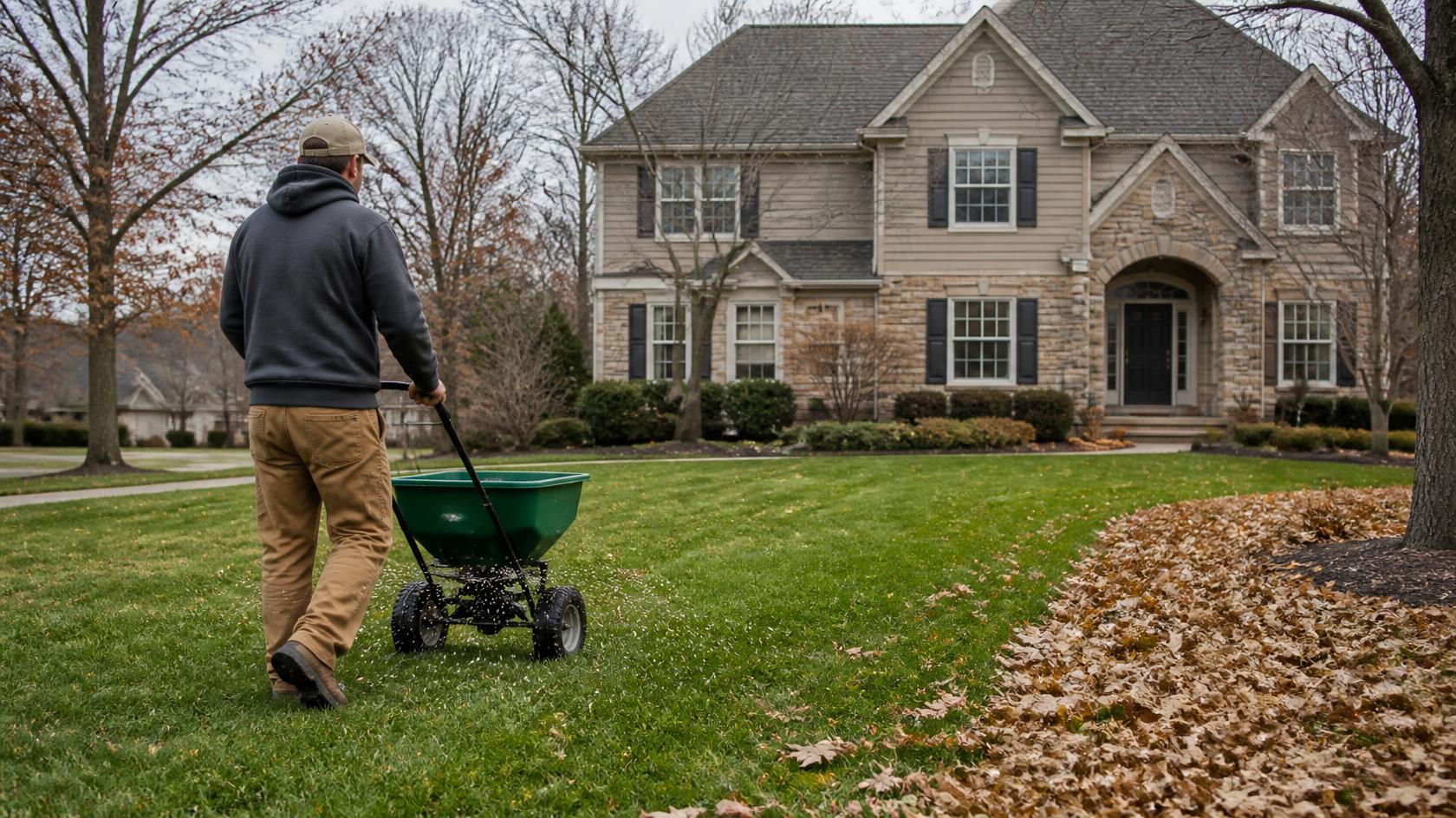
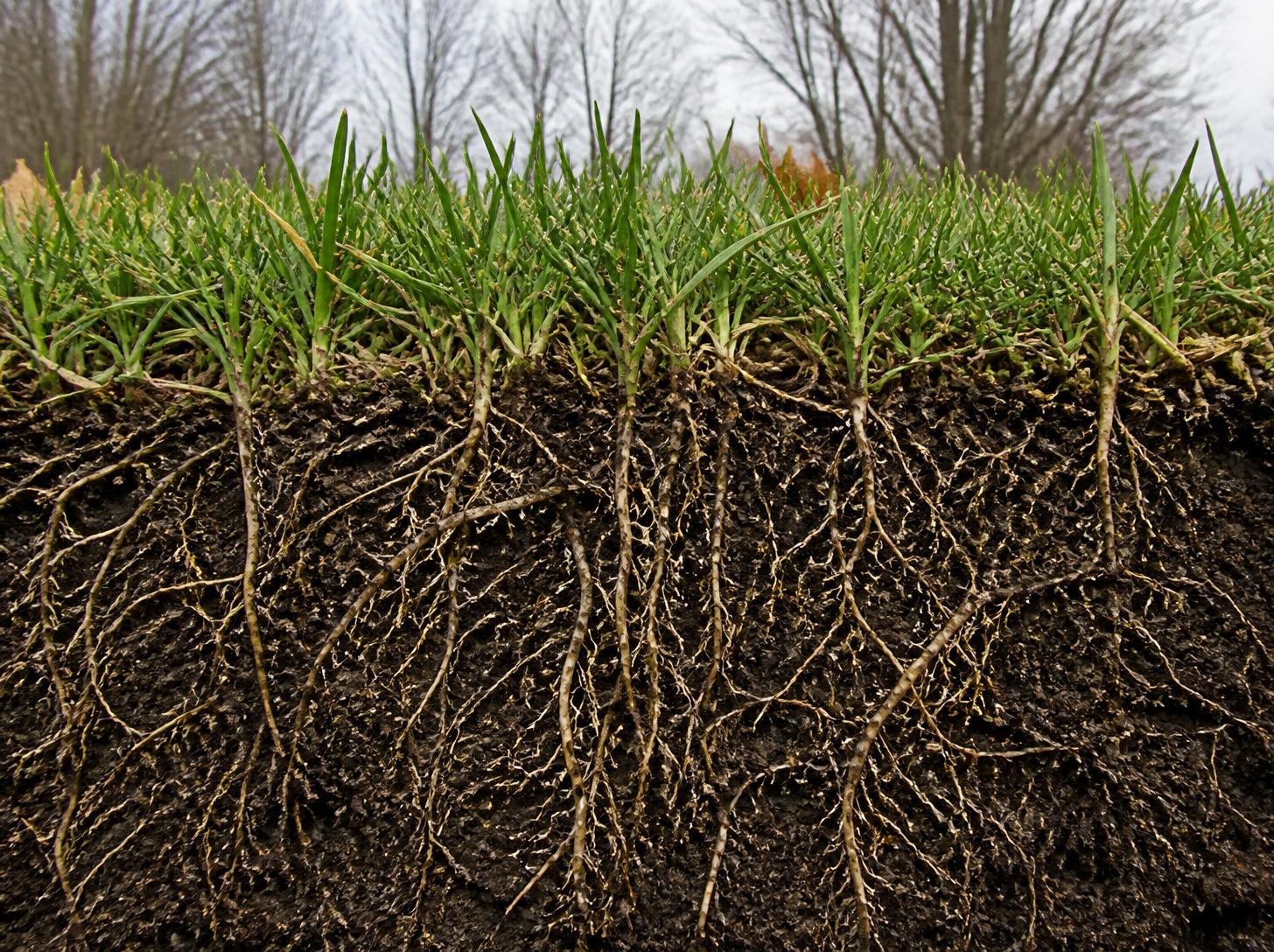
“Winterizer” isn’t a magic ingredient it’s a fertilizer applied as the final feeding of the fall, designed to prepare a cool-season lawn for winter and set it up for spring. The idea is simple: feed the lawn one last time while the roots are still active, so the plant banks nutrients it will use the moment it wakes up in spring. The grass isn’t putting on much visible top growth by late fall, but below the surface the roots are still working, and the warm soil keeps them taking up nutrients. Those stored reserves are the whole point they’re what makes a winterized lawn green up earlier, thicker, and stronger than one that went into winter unfed.
Nitrogen or potassium? The winterizer debate (and the Kansas answer)
Here’s where you’ll find conflicting advice online, so it’s worth getting straight. Many national products and articles define a “winterizer” as a fertilizer that’s high in potassium and low in nitrogen, on the logic that potassium builds cold hardiness and disease resistance. Potassium does help with those things that part is true.
But for cool-season lawns in Kansas specifically, Kansas State University’s guidance is clear: nitrogen is the key element for the late-fall feeding. K-State recommends a high-nitrogen, quick-release fertilizer for the November application products in the range of 27-3-3 or 30-0-3 because that nitrogen is taken up by the plant and stored, then used for spring green-up. Research has shown that nitrogen applied in fall gets converted to stored energy, while the same nitrogen applied in spring mostly goes to top growth (more mowing, little root benefit). Local garden centers reflect this too: the “Winterizer” sold here runs around 25-0-6 clearly nitrogen-led.
The practical takeaway for an Overland Park lawn: a late-fall feeding that delivers nitrogen for root storage, with potassium supporting hardiness, is what our cool-season grass actually needs not the low-nitrogen, high-potassium product that generic national advice recommends. Getting this right is exactly the kind of local detail that separates a lawn that comes back strong from one that limps into spring.
When to apply winterizer in Kansas City
Timing is critical the window is real, and missing it in either direction wastes the application:
| Timing cue | Target | Why |
|---|---|---|
| Calendar | Late October – November (into early Dec in mild years) | The KC cool-season late-fall window |
| Your lawn | Around your last mow of the season | Growth has slowed but grass is still green |
| Soil temperature | Roughly 50–55°F and cooling | Roots still active and taking up nutrients |
| The deadline | Before the ground freezes | Frozen ground = roots can’t absorb it |
Apply too early on a warm September day while the grass is still actively growing and you can push tender new growth right before frost. Apply too late after the ground has frozen and the grass is fully dormant and the roots can’t take the nutrients up. The sweet spot is that narrow window when the lawn has stopped actively growing but is still green and the roots are still working below the surface. In Johnson County, that’s typically around your final mowing.
The winterizer window is short don’t miss the feeding that sets up your spring lawn. Get your winterizer feeding scheduled or call (913) 829-4949.
Why the winterizer may be your highest-ROI feeding
If you measure fertilizer by results-per-dollar, the winterizer is hard to beat for one powerful reason: it replaces your early-spring feeding and does the job better. K-State’s research is blunt about it: nitrogen applied in late fall is stored in the roots and used efficiently for spring green-up, while nitrogen applied in early spring mostly produces a flush of top growth with little root benefit. So the winterizer isn’t an extra feeding stacked on top of spring it’s a smarter substitute for it.
That means a lawn fed with a proper winterizer:
- Greens up earlier and more vigorously in spring the nutrients are already in place when the grass wakes up.
- Builds stronger roots over winter, which drives better top growth all of next year.
- Comes through winter more resilient better cold hardiness and disease resistance.
- Needs less from you in early spring, avoiding the excess-mowing flush that early-spring nitrogen causes.
Skip it, and the opposite happens: the lawn goes into winter under-fueled and comes back thin, slow, and nutrient-deficient, making for a harder growing season. For one well-timed application, the spring payoff is enormous.
Where the winterizer fits in the fall sequence
The winterizer is the final step in a fall sequence that, done fully, transforms a lawn. Earlier in the fall around Labor Day is the ideal time for the big recovery feeding and for aeration and overseeding earlier in fall to relieve compacted clay and thicken thin turf. The winterizer then caps the season, banking nutrients for spring. Together, the early-fall work and the late-fall winterizer are why fall is the most important season for a cool-season lawn and why a lawn cared for properly in fall simply outperforms one that isn’t, every spring. The winterizer is the last move, but it’s only as good as the foundation laid earlier in the season.
DIY vs. letting a program handle it
You can apply a winterizer yourself the challenge is the narrow timing window and getting the product right. Apply too early and you risk frost-tender growth; too late and it’s wasted; use a low-nitrogen national “winterizer” and you’ve under-fed the root storage our Kansas lawns actually need. A professional program removes all of that: the winterizer goes down in the correct window, with the right nitrogen-led product for our cool-season grass, at a calibrated rate as the last of a season of properly-timed feedings. For most homeowners, the winterizer is the easiest feeding to forget and the costliest to get wrong, which makes it one of the strongest arguments for being on a professional lawn fertilization program in the first place.
Make sure the most important feeding of the year actually happens. Get your winterizer feeding scheduled] or call (913) 829-4949 timed right, for Overland Park lawns.
Why Overland Park homeowners choose MW Lawn & Landscape
The winterizer is all about timing and the right product for our grass and after 25+ years in Johnson County, that’s exactly what we deliver:
- We time it to the window. The winterizer goes down in the narrow late-fall sweet spot after growth slows, while roots are still active, before the ground freezes.
- We use the right product for Kansas lawns. A nitrogen-led late-fall feeding per K-State guidance built for root storage and spring green-up, not the generic low-N national ‘winterizer.’
- It’s the last step of a full fall program. Following the Labor Day feeding and aeration and overseeding earlier in fall, the winterizer caps a season built for a thick spring lawn.
- You never have to remember it. On our program, the easiest-to-forget feeding simply happens, on time, every year.
- Family-owned, licensed, and insured, serving Overland Park and Johnson County since 2000.
Serving Overland Park, Lenexa, Olathe, and Johnson County
MW Lawn & Landscape applies properly-timed winterizer feedings across Overland Park, Lenexa, Olathe, and the surrounding Johnson County communities the right product, in the right window, as the last step of a season-long program. If you want your lawn to be the first on the block to green up next spring, the winterizer is how you get there. We’ll make sure it happens, done right the way we have for local homeowners since 2000.
Frequently Asked Questions
What is winterizer fertilizer?
Winterizer fertilizer is the final feeding of the fall, applied to a cool-season lawn as growth slows but the grass is still green. It feeds the lawn one last time while the roots are still active, so the plant stores nutrients to use for an early, vigorous green-up in spring. It’s not a special ingredient it’s a fall-timed feeding whose stored nutrients are what make a winterized lawn come back thicker and faster than an unfed one.
When should you apply winterizer in Kansas City?
Roughly late October through November in the Kansas City area around your last mow of the season, when growth has slowed but the grass is still green and soil temperatures are around 50 to 55 degrees. It must go down before the ground freezes, while the roots can still take up nutrients. Applying too early risks frost-tender growth; applying after the ground freezes wastes it. The sweet spot is that narrow late-fall window.
Should winterizer be high in nitrogen or potassium?
For cool-season lawns in Kansas, Kansas State University recommends a high-nitrogen late-fall feeding nitrogen is the key element, because it’s stored in the roots and used for spring green-up. This differs from many national ‘winterizer’ products that are high in potassium and low in nitrogen. Potassium does support cold hardiness, but for our tall fescue and bluegrass lawns, a nitrogen-led feeding (products like 27-3-3 or a local 25-0-6) is what K-State calls for.
Why is the winterizer called the most important feeding?
Because it replaces your early-spring feeding and does the job better. K-State research shows nitrogen applied in late fall is stored in the roots and used efficiently for spring green-up, while the same nitrogen applied in early spring mostly produces top growth with little root benefit. So a well-timed winterizer gives you an earlier, thicker spring green-up, stronger roots, and better winter resilience a large payoff from a single application.
What happens if I skip the winterizer feeding?
Your lawn goes into winter under-fueled and comes back thin, slow, and nutrient-deficient in spring, making for a harder growing season. Without the stored nutrients, the grass has nothing to draw on for an early green-up, so it greens up later and weaker than a winterized lawn. The winterizer is one of the easiest feedings to forget and one of the costliest to skip, given how much it affects next year’s lawn.
Can I apply winterizer too late?
Yes. If you apply it after the ground has frozen and the grass has gone fully dormant, the roots can’t take up the nutrients and the application is largely wasted. The goal is to apply while the lawn has stopped actively growing but is still green and the roots are still working below the surface typically around your last mow. In a mild year the window can stretch into early December, but before a hard freeze is the rule.
Do I still need to fertilize in spring if I apply a winterizer?
Not heavily. K-State actually advises against heavy early-spring fertilization because it produces excess top growth with little root benefit and a proper winterizer already stores the nutrients the lawn needs for spring green-up. The lawn simply uses what it needs when it wakes up. A light later-spring feeding has its place, but the winterizer does the heavy lifting, which is part of why it’s so valuable.
Should I aerate and overseed before the winterizer?
Yes those are earlier-fall jobs. The ideal fall sequence is core aeration and overseeding plus the big recovery feeding around Labor Day, then the winterizer as the final late-fall feeding. Aeration relieves compacted clay and sets up overseeding, while the winterizer caps the season by banking nutrients for spring. The winterizer is the last step, but it works best on top of the aeration, overseeding, and feeding done earlier in fall.