
When your yard won’t drain, a quick search turns up two solutions that sound similar a French drain and a catch basin and it’s not obvious which one fixes your problem. Here’s the short version before we dig in: they solve two different kinds of water. A French drain handles water in the soil (the ground stays soggy and saturated); a catch basin handles water on the soil (a puddle that pools in a low spot). Pick the wrong one and you’ve spent money without fixing the problem. This guide explains the difference in plain terms, shows you how to tell which your yard needs, and covers when you actually want both. And because the right answer depends on where your water really is, our professional French drain installation always starts by diagnosing that first.
THE SHORT ANSWER
French drain: for subsurface water saturated, soggy ground and seepage. It collects water along its whole length, underground. Catch basin: for surface water a puddle that pools in one specific low spot. It captures water at a single point and pipes it away. How to choose: soggy ground = French drain; standing puddle in a low spot = catch basin. Often: yards need both, working together.
The core difference: in the soil vs. on the soil
Almost everything about choosing between these two comes down to one question: is your water in the ground or on it?
A French drain deals with subsurface water water saturating the soil itself. It’s a gravel-filled trench with a perforated pipe that gives groundwater an easier path than the dense clay around it, collecting water along its entire length and carrying it by gravity to a discharge point. You reach for it when the ground stays soggy and spongy for days, when there’s seepage, or when water is pushing against a foundation.
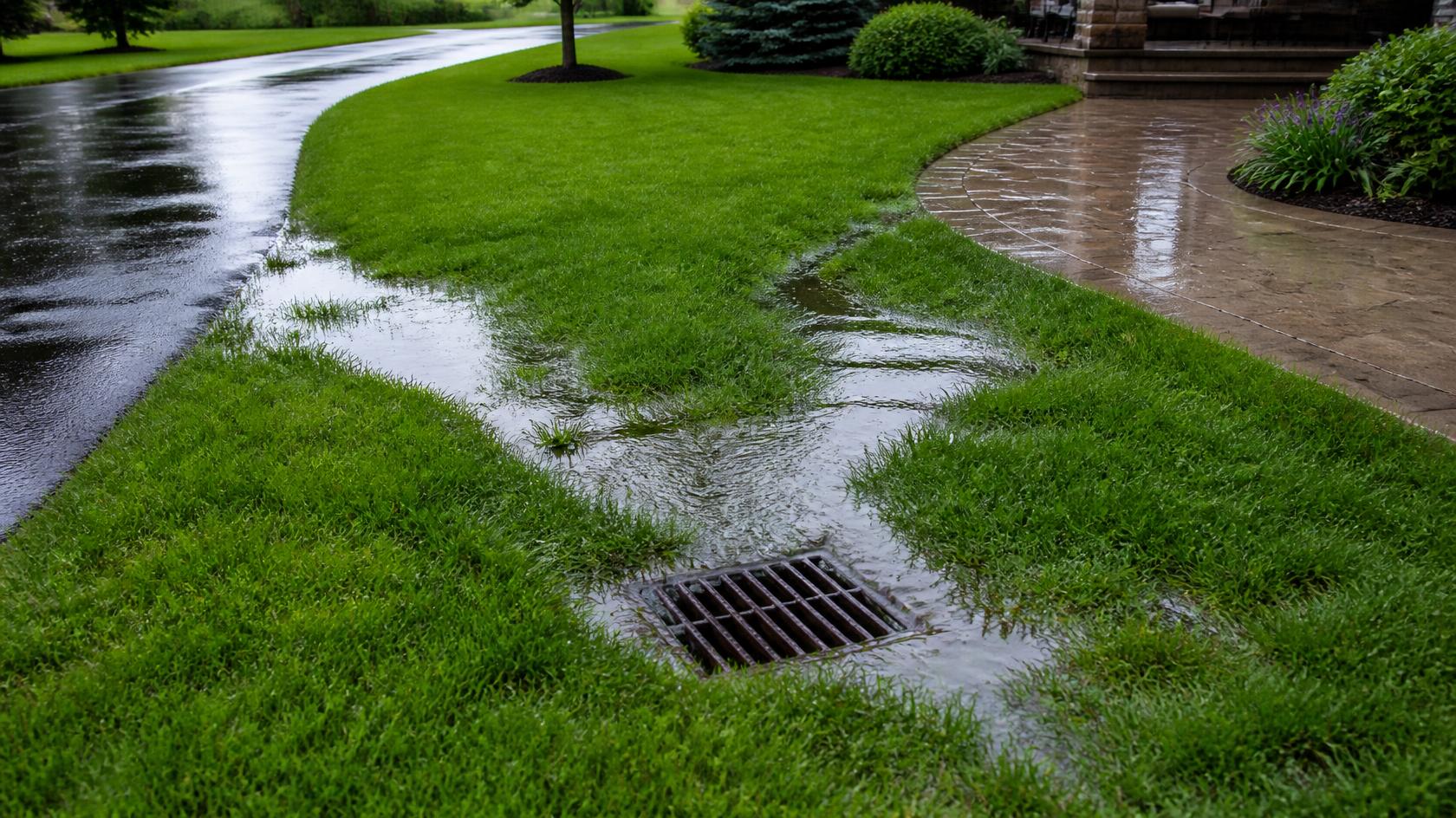
A catch basin deals with surface water water pooling on top of the ground. It’s a grated box set into a low spot that captures runoff at that single point and pipes it away underground. You reach for it when water collects in the same specific place every storm the corner of a patio, a dip in the lawn, the bottom of a driveway and just sits there.
That’s the whole distinction in a sentence: a French drain collects water spread through the soil along a line; a catch basin collects water pooled on the surface at a point. Match the tool to where your water actually is, and the choice is usually obvious.
French drain vs. catch basin, side by side
| French drain | Catch basin | |
|---|---|---|
| Handles | Subsurface water (in the soil) | Surface water (on the soil) |
| Collects water | Along its whole length (a line) | At one point (the grate) |
| Best for | Soggy ground, seepage, foundation water | A puddle in a specific low spot |
| What it looks like | Buried gravel trench (often invisible) | A visible grate at ground level |
| Common trigger | Ground stays spongy for days after rain | Water pools in the same spot every storm |
| Often paired with | A catch basin, downspouts, grading | A French drain or piped outlet |
Neither is “better” they’re built for different problems. A French drain in a spot that only has surface pooling is overkill; a catch basin on chronically saturated ground won’t touch the real issue.

Should I use a French drain or a catch basin?
Walk your yard after a good rain and look at what the water is doing:
You likely need a French drain if…
- The ground stays soggy, soft, and spongy for a day or more after rain.
- You see seepage, or water showing up against or near the foundation.
- There’s no single puddle a whole area just stays saturated.
- A low, wet strip runs along a slope or between properties.
You likely need a catch basin if…
- Water pools in one specific low spot the same place every storm.
- The puddle sits on top and eventually, slowly, soaks in or evaporates.
- It’s at the base of a patio, driveway, or a clear dip in the lawn.
- The surrounding ground is otherwise fine just that one spot collects.
If you’re not sure or you see both that’s normal, and it’s exactly what a professional assessment is for. Reading water wrong is the most expensive mistake in drainage, so it’s worth getting the diagnosis right before anyone digs.
Not sure whether your water is on the surface or in the soil? That diagnosis decides everything. Get a free drainage assessment or call (913) 829-4949.
When you need both (and how they work together)
Plenty of Johnson County yards have both problems at once surface pooling and saturated soil and the best solution combines the two. A common setup: a catch basin captures the surface puddle at its low point, then pipes into (or runs alongside) a French drain that handles the subsurface water, and both carry water to a single discharge point. The catch basin grabs what’s on top; the French drain grabs what’s underneath; together they dry the area out completely.
This is why the honest answer to “which one?” is often “both, in the right places” and why a drainage plan is more than picking one product from a shelf. It’s also why these two are usually part of the full range of yard drainage solutions rather than standalone fixes.
Don’t forget the cheaper fixes first
Before committing to either, it’s worth ruling out the simpler, cheaper solutions because sometimes neither a French drain nor a catch basin is what you actually need. The most common culprits:
- Downspouts dumping at the foundation. The single most common drainage problem there is. burying your downspouts and popping them up out in the yard fixes a surprising number of “drainage” complaints for a fraction of the cost.
- Ground sloping toward the house. Sometimes the fix isn’t a pipe at all it’s regrading or a swale to reshape the ground so water runs away from the home.
- Runoff that needs directing. a dry creek bed can move surface water along an attractive path and double as a landscape feature.
A good drainage company diagnoses the real cause first and reaches for the simplest fix that works sometimes that’s a French drain, sometimes a catch basin, and sometimes it’s a downspout you could have fixed for a fraction of the price.
Let’s find out what your yard actually needs. Get a free drainage assessment or call (913) 829-4949 honest diagnosis, then the right fix.
Why Johnson County homeowners choose MW Lawn & Landscape
The choice between a French drain and a catch basin is really a diagnosis and after 25+ years in Johnson County clay, that’s what we lead with:
- We diagnose before we trench. Not every wet yard needs a French drain if a catch basin, a buried downspout, or a regrade solves it, that’s what we’ll tell you, even when it’s the smaller job.
- We know this clay. We’ve worked Johnson County’s soil since 2000 and know how water actually moves through it on the surface and below it.
- We build the whole system. Surface and subsurface, professional French drain installation or a catch basin or both, sloped to a real discharge point that actually carries water away.
- We restore your lawn. Drainage crews trench and leave a scar; we’re your lawn company, so we grade and reseed the line back in.
- Family-owned, licensed, insured, and warrantied local accountability on work built to last.
Serving Olathe, Overland Park, and Johnson County
MW Lawn & Landscape solves surface and subsurface drainage problems across Olathe, Overland Park, and the surrounding Johnson County communities French drains, catch basins, buried downspouts, grading, and dry creek beds, alone or in combination. Because the right fix depends on where your water actually is, we start by finding that out, then build the solution that dries your yard for good the way we have for local homeowners since 2000.
Frequently Asked Questions
Should I use a French drain or a catch basin?
It depends on where your water is. Use a French drain for subsurface water when the ground stays soggy and saturated, there’s seepage, or water is near the foundation. Use a catch basin for surface water when a puddle pools in one specific low spot every storm. A French drain collects water spread through the soil along its length; a catch basin captures water pooled on the surface at a single point. Many yards need both.
What’s the difference between a French drain and a catch basin?
A French drain handles water in the soil: it’s a buried gravel trench with a perforated pipe that collects groundwater along its whole length and carries it to a discharge point. A catch basin handles water on the soil: it’s a grated box set into a low spot that captures surface runoff at that point and pipes it away. The key difference is subsurface (French drain) versus surface (catch basin) water.
Can you use a French drain and catch basin together?
Yes, and it’s common. Many yards have both surface pooling and saturated soil, so a catch basin captures the surface puddle at its low point and pipes into or alongside a French drain that handles the subsurface water, with both draining to one discharge point. The catch basin grabs what’s on top, the French drain grabs what’s underneath, and together they dry the area out completely.
How do I know if my water is surface or subsurface?
Watch your yard after a good rain. If water pools on top in a specific spot and slowly soaks in or evaporates, it’s surface water a catch basin’s job. If the ground stays soggy, soft, and spongy for a day or more across an area, or you see seepage, it’s subsurface water a French drain’s job. A quick test: surface water usually drains within hours once rain stops; subsurface saturation lingers for a day or more.
Is a catch basin cheaper than a French drain?
Often, yes, for a single problem spot a catch basin addresses one low point, while a French drain is a longer trench system. But they’re not interchangeable, so cost shouldn’t drive the choice: a cheaper catch basin won’t fix saturated soil, and an unnecessary French drain is overkill for a simple surface puddle. The right (and most cost-effective) solution is the one matched to your actual water problem, which an assessment identifies.
What if neither fixes my drainage problem?
Sometimes the real cause is simpler downspouts dumping water at the foundation, or ground that slopes toward the house. Burying downspouts to pop up out in the yard, or regrading and adding a swale, solves a surprising number of drainage complaints for less than a full drain system. A good drainage company diagnoses the actual cause first and recommends the simplest fix that works, rather than defaulting to a trench.
Do French drains and catch basins need maintenance?
Both need very little. For a catch basin, keep leaves and debris off the grate so water can enter freely. For a French drain, check the discharge point after big storms to confirm water runs out. A properly built French drain washed stone, fabric-wrapped, correct fall runs for years without attention. The most important maintenance for either is keeping the discharge point and any surface inlets clear.
Which lasts longer, a French drain or a catch basin?
Both are long-lasting when built correctly, since neither has moving parts. A French drain’s longevity depends on washed stone, filter fabric, and proper slope get those right and it lasts many years. A catch basin lasts as long as its grate and piping stay clear and intact. In both cases, correct installation and a working discharge point matter far more than the device itself for how long the system keeps performing.