
If you’re about to dig a French drain, the first question is always the same: how deep? It’s the right thing to ask, because depth along with trench width and slope is what determines whether your drain quietly works for decades or clogs and fails in a couple of seasons. And the honest answer is: it depends on what you’re draining. A drain pulling surface water off a soggy lawn has a different depth than one protecting a foundation. This guide gives you the real numbers for each situation, plus the trench width and the all-important slope, and walks through how to lay a French drain correctly with special attention to Johnson County’s clay soil, which is far less forgiving of shortcuts than sandy ground. When you’d rather have it dug right the first time, our professional French drain and drainage installation gets the depth, slope, and materials correct for our soil.
THE SHORT ANSWER
Yard / surface drain: about 18–24 inches deep (12 inches minimum). Foundation drain: deeper down to or below the footing, often 3–6+ feet. Trench width: roughly 6–12 inches. Slope (non-negotiable): at least 1% about 1 inch of drop per 8–10 feet toward the outlet. Golden rule: the drain must sit below the water you’re collecting and run continuously downhill to daylight.
How deep does a French drain need to be?
Depth is driven by purpose the drain has to sit below the water it’s meant to collect. Here are the real numbers for the common situations:
| Drain purpose | Typical depth | Why |
|---|---|---|
| Surface / yard water | 18–24 inches (12″ min) | Deep enough to collect saturated topsoil and run to an outlet. |
| Lawn with heavier flow | 24 inches+ | More depth = more gravel volume and capacity. |
| Foundation / footing drain | At or below the footing (often 3–6 ft) | Must sit below the water reaching the foundation to protect it. |
| Curtain drain (intercepting slope water) | 24–36 inches | Deep enough to cut off water moving downhill toward the house. |
The principle behind all of these: a French drain works by giving water an easier path than the surrounding soil, so it must sit below the water it’s collecting. Too shallow and the water never reaches it. For a standard soggy-yard problem, 18 to 24 inches is the sweet spot. For anything touching your foundation, depth increases significantly and that’s professional territory, because a foundation drain done wrong can make things worse.
How wide should a French drain trench be?
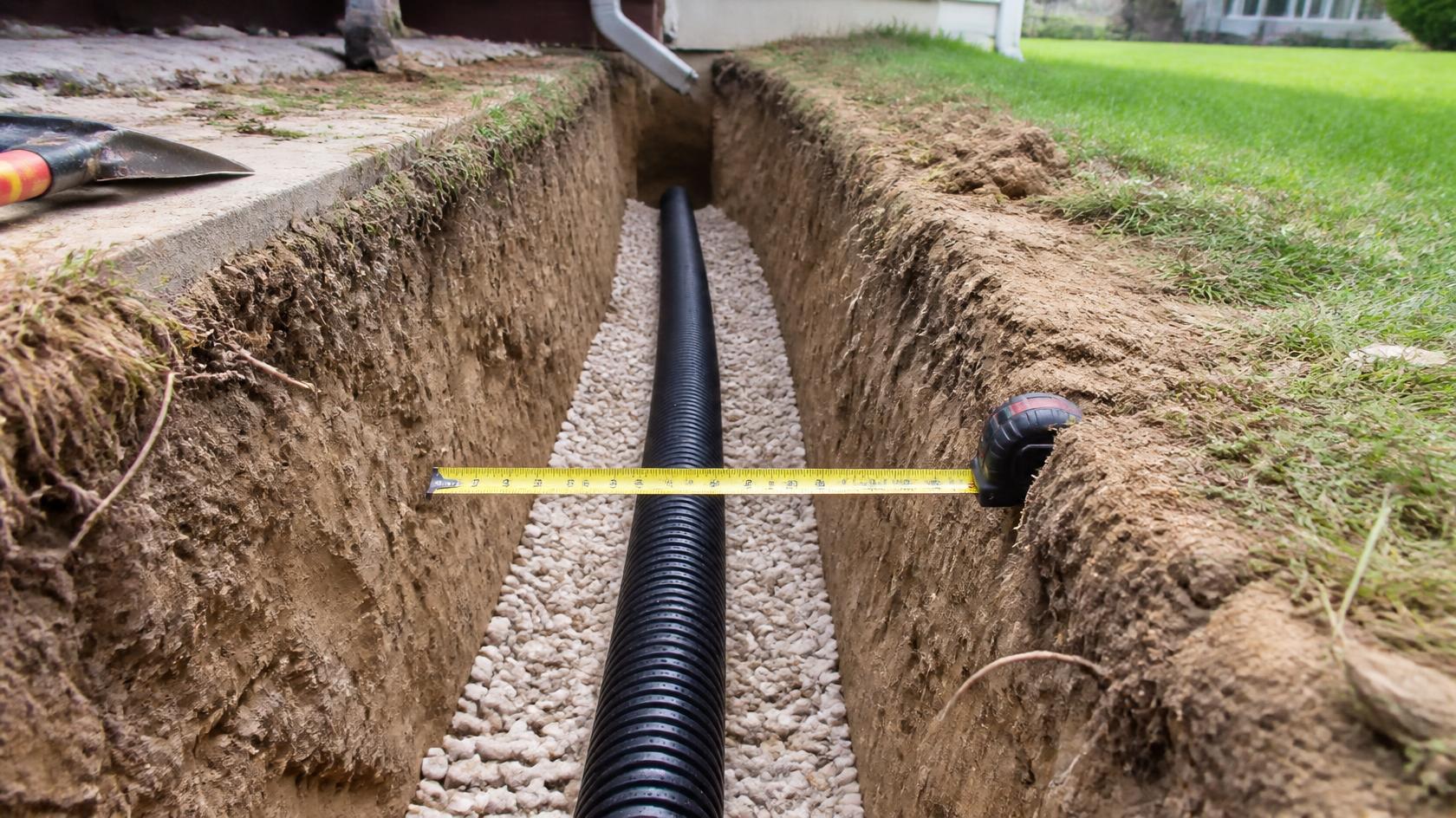
Trench width gets less attention than depth, but it matters for capacity and for fitting the pipe and gravel. For most residential French drains, a width of about 6 to 12 inches works well roughly the width of a shovel blade to a foot across. Narrower (around 6 inches) is fine for a simple yard drain with a standard 4-inch pipe; wider (up to 12 inches or more) increases gravel volume and drainage capacity for higher-flow situations. The trench needs to be wide enough to surround the perforated pipe with gravel on all sides the gravel is the collection zone, so the pipe shouldn’t be crammed against the trench walls.
The slope: the number that actually makes it work
If depth and width are important, slope is non-negotiable it’s the single most common reason a French drain fails. A French drain moves water by gravity, so the trench must fall continuously toward the outlet the entire way. The minimum grade is 1%, which works out to about 1 inch of drop for every 8 to 10 feet of run (roughly an eighth of an inch per foot). More is fine; less is trouble.
Get this wrong and water pools in the low spots of the pipe instead of flowing out, and the drain effectively stops working no matter how deep or wide you dug it. This is why professionals shoot the grade with a level rather than eyeballing it: a trench that looks downhill to the eye can easily have a dead-flat or even backward section. Consistent fall to a real outlet (daylight, a dry well, or a storm line) is what turns a gravel trench into a working drain.
Not sure how deep your situation needs or where the water should go? Depth and slope depend on your yard. Get a free drainage assessment or call (913) 829-4949.
How to lay a French drain, step by step
Once you know your depth, width, and slope, here’s how a French drain goes in correctly:
- 1. Plan the route and outlet. Map the trench from the wet area to a lower outlet daylight, a dry well, or a storm connection. No outlet, no drain. Call 811 to locate utilities before you dig.
- 2. Dig to depth and slope. Excavate the trench to your target depth and width, maintaining at least 1% continuous fall the whole way. Check the grade with a level, not your eye.
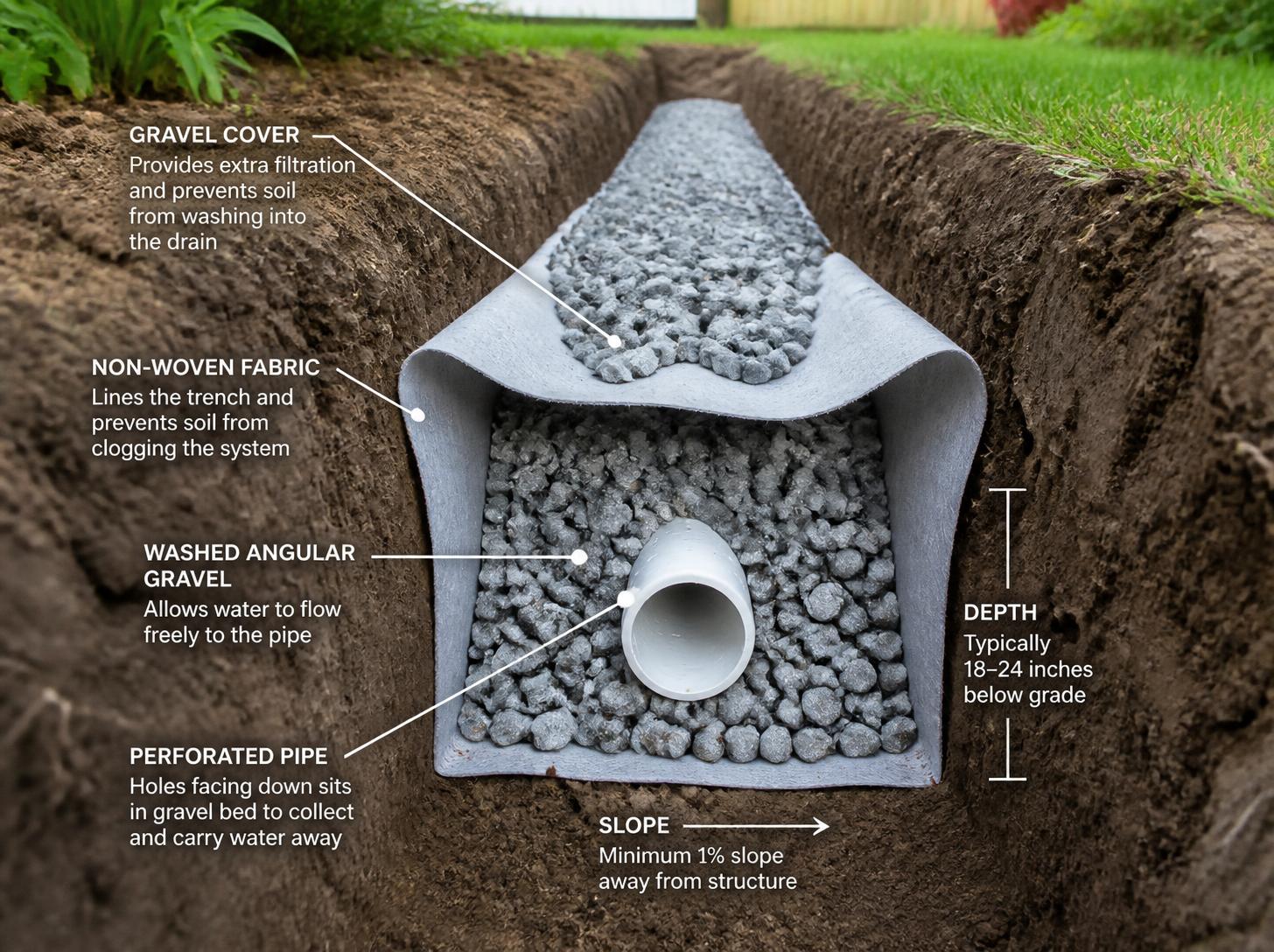
- 3. Line with filter fabric. Lay non-woven filter fabric in the trench, edges long enough to fold over the top later. In clay, this is what keeps silt out and the drain alive more on which rock goes in the trench and the fabric that goes with it.
- 4. Add a gravel base. A few inches of washed, angular gravel in the bottom, keeping the slope.
- 5. Lay the perforated pipe holes DOWN. Set the perforated pipe on the gravel base with the holes facing DOWN (see below this surprises people). Maintain the slope.
- 6. Surround with gravel. Fill washed gravel around and over the pipe this is the collection zone.
- 7. Wrap and cap. Fold the filter fabric over the top of the gravel to seal it, then cap with soil and sod, or with decorative river rock for a dry-creek finish.
Wait pipe holes UP or DOWN?
This is the detail almost everyone gets wrong. For a French drain collecting groundwater (the usual residential job), the perforated pipe goes in with the holes facing DOWN. It feels backwards, but here’s the logic: the goal is to collect water that has risen up through the soil and drain it away, so water enters the pipe from below and the holes-down orientation lets it in at the lowest point, then carries it off. Holes-up would only make sense if you were trying to let water out of the pipe, not collect it. If you take one technical detail from this guide, make it this one it’s the difference between a drain that collects efficiently and one that doesn’t.
Why Kansas clay makes depth and slope unforgiving
Everything above matters more in Johnson County than in sandy regions, because our heavy clay is unforgiving of a lazy install. Clay drains slowly and holds water, so a drain that’s too shallow sits in perpetually saturated soil; clay silt clogs a poorly built drain fast, which is why filter fabric and washed (not dirty) gravel aren’t optional here; and our freeze-thaw cycles mean a drain that’s too shallow can be affected by frost. In practice, that means erring toward the deeper end of the range, being religious about slope, and never skipping the fabric. A French drain that would limp along in sandy soil will simply fail in clay if the depth, slope, and materials aren’t right which is exactly why so many DIY drains here quit working within a few seasons.
DIY vs. professional: where depth trips people up
A simple, shallow yard drain in an accessible spot is a legitimate DIY project if you respect the slope and the fabric. Where DIY goes wrong is usually one of three things: not enough depth (the drain sits above the water), inconsistent slope (water pools in the pipe), or skipping fabric (clay silt clogs it). And anything involving your foundation is firmly professional the depths get large, the stakes are your home, and a mistake is expensive to undo because it’s all buried. The most valuable thing a pro brings isn’t the digging; it’s shooting the grade correctly and knowing how deep your specific problem actually needs to go. If it’s a simple lawn puddle, you may well DIY it; if it’s near the house or you’re unsure where the water’s coming from, an assessment pays for itself.
Want it dug to the right depth and slope the first time? Get a free drainage assessment or call (913) 829-4949 we build for clay, to a real outlet.
Why Johnson County homeowners choose MW Lawn & Landscape
A French drain lives or dies on the numbers you can’t see once it’s buried and after 25+ years in Johnson County clay, we get them right:
- Right depth for the job. Surface, curtain, or foundation we dig to the depth your specific water problem needs, not a one-size number.
- Slope shot with a level. We grade the trench to a real, continuous fall toward a proper outlet the step that actually makes a drain work.
- Built for clay. Non-woven fabric, washed angular gravel, and pipe set correctly the materials and methods that keep a drain alive in our silt-heavy soil.
- The whole system. From the trench to a dry-creek finish, drainage ties into professional French drain and drainage installation and the rest of your yard.
- Family-owned, licensed, and insured local accountability on work built to last decades.
Serving Olathe, Overland Park, and Johnson County
MW Lawn & Landscape installs French drains and complete drainage systems across Olathe [/olathe/], Overland Park [/overland-park/], and the surrounding Johnson County communities dug to the right depth, graded to a real slope, and built with the fabric and stone our clay demands. Whether it’s a soggy lawn or water near the foundation, we’ll find where the water’s coming from and build a drain that actually carries it away the way we have for local homeowners since 2000.
Frequently Asked Questions
How deep does a French drain need to be?
It depends on the purpose. A standard yard or surface-water drain is typically 18 to 24 inches deep (12 inches minimum), while a foundation or footing drain must go deeper down to or below the footing, often 3 to 6 feet. A curtain drain intercepting slope water usually runs 24 to 36 inches. The key principle is that the drain must sit below the water it’s collecting, and always slope continuously to an outlet.
How wide should a French drain trench be?
For most residential French drains, 6 to 12 inches wide works well roughly a shovel blade to a foot across. Around 6 inches suits a simple yard drain with a standard 4-inch perforated pipe, while wider trenches increase gravel volume and drainage capacity for higher flow. The trench must be wide enough to surround the pipe with gravel on all sides, since the gravel is the collection zone.
What slope does a French drain need?
At least 1% about 1 inch of drop for every 8 to 10 feet of run, or roughly an eighth of an inch per foot continuously toward the outlet. Slope is the most common reason French drains fail; without consistent fall, water pools in the pipe instead of draining out, no matter how deep the trench. Professionals check the grade with a level rather than by eye, since a trench that looks downhill can have flat or backward sections.
Should the pipe holes face up or down in a French drain?
For a French drain collecting groundwater the usual residential job the perforated pipe goes in with the holes facing DOWN. The goal is to collect water rising up through the soil and carry it away, so holes-down lets water enter at the lowest point. It feels backwards, but holes-up would only make sense if you were trying to release water from the pipe rather than collect it. This is the detail most DIYers get wrong.
How do you lay a French drain?
Plan the route to a lower outlet and call 811 first. Dig the trench to depth and width with at least 1% continuous slope. Line it with non-woven filter fabric, add a gravel base, lay the perforated pipe with holes down, surround it with washed gravel, then fold the fabric over the top and cap with soil, sod, or decorative rock. Maintaining the slope throughout and wrapping the gravel in fabric are what make it last.
How deep should a French drain be near a foundation?
A foundation or footing drain must sit at or below the level of the footing, which often means 3 to 6 feet deep or more depending on the home. This is significantly deeper than a yard drain because it has to intercept water before it reaches the foundation. Because of the depth and the stakes involved, foundation drainage is professional work a mistake here can worsen the problem or damage the structure.
Can a French drain be too shallow?
Yes, and it’s a common mistake. A drain that’s too shallow sits above the water it’s meant to collect, so the water never reaches it and the drain does nothing. In Kansas clay, a too-shallow drain also sits in perpetually saturated soil and can be affected by frost. For a standard yard problem, 18 to 24 inches is the target depth; going shallower to save digging usually means the drain won’t work.
Does a French drain need to slope the whole way?
Yes. A French drain moves water entirely by gravity, so it must fall continuously toward the outlet along its whole length at least 1% grade. A single flat or reverse section becomes a low spot where water collects and stalls, effectively stopping the drain. This is why consistent slope, checked with a level, matters as much as depth, and why the drain must always end at a lower outlet that lets the water out.