
A French drain solves a wet yard; river rock makes it look like it was always meant to be there. Put them together and you get the best of both a drainage system that quietly moves water away from your foundation, topped with clean, natural stone that reads as a designed landscape feature instead of a scar across the lawn. But there’s a detail most homeowners get wrong, and it’s the whole point of this guide: the rock you see on top and the rock that does the work underground are not the same rock. Use the wrong stone in the trench and your beautiful drain clogs and fails in a few years. This guide explains exactly which rock goes where, what size and type to use, what to avoid, and why the French-drain-plus-river-rock combo is so popular in Johnson County. When you want it built right, our river rock and drainage installation handles both layers correctly.
THE SHORT ANSWER
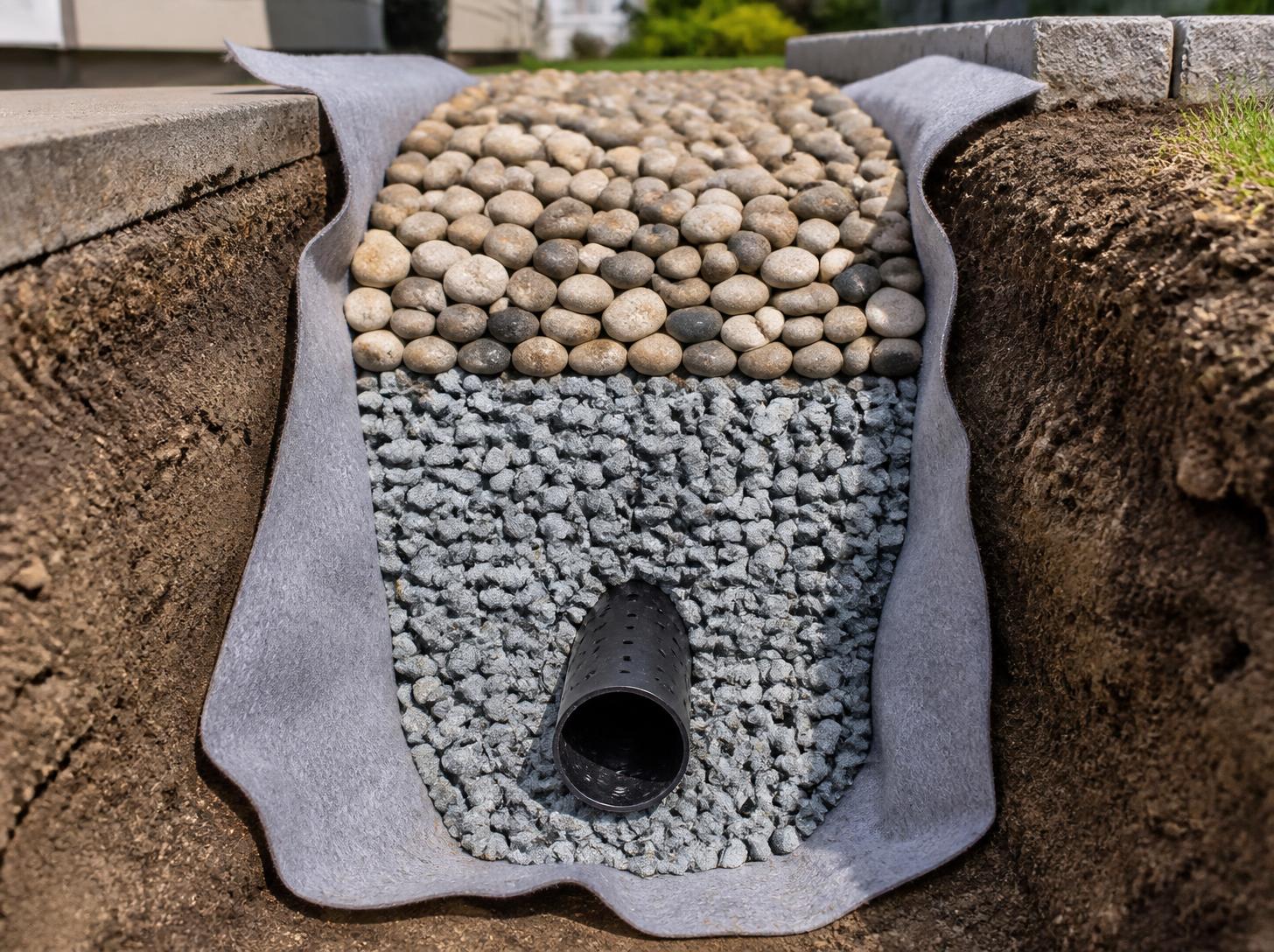
Around the pipe (the working fill): washed, angular crushed stone 3/4-inch (#57) is the standard. It interlocks, holds open drainage voids, and won’t compact. On top (the decorative layer): smooth river rock, for the clean dry-creek look. Never use: pea gravel or any unwashed ‘dirty’ stone as the trench fill it clogs the system. The rule: crushed stone is the engine; river rock is the finish.
Why pair a French drain with river rock?
A French drain is, by itself, a gravel-filled trench with a perforated pipe highly effective, but not much to look at if it surfaces in your yard. That’s where river rock comes in. Topping the drain with decorative river rock turns a purely functional trench into a dry creek bed: an attractive, natural-looking stone channel that handles storm runoff while looking like an intentional design element. You get the drainage performance underground and curb appeal on top. For a lot of Johnson County yards, that combination is the ideal solution it fixes the water problem and improves the look of the property at the same time, instead of leaving a strip of bare gravel or disturbed turf.
The combo works because each material plays to its strength. The buried crushed stone moves water; the river rock on top resists washout, never needs replacing, and frames the feature. Understanding how a French drain actually works makes it clear why the two layers do different jobs.
The key distinction: trench fill vs. decorative top
This is the part that trips up almost every DIYer, so let’s be crystal clear. A French-drain-with-river-rock has two different rock layers, and they have opposite requirements:
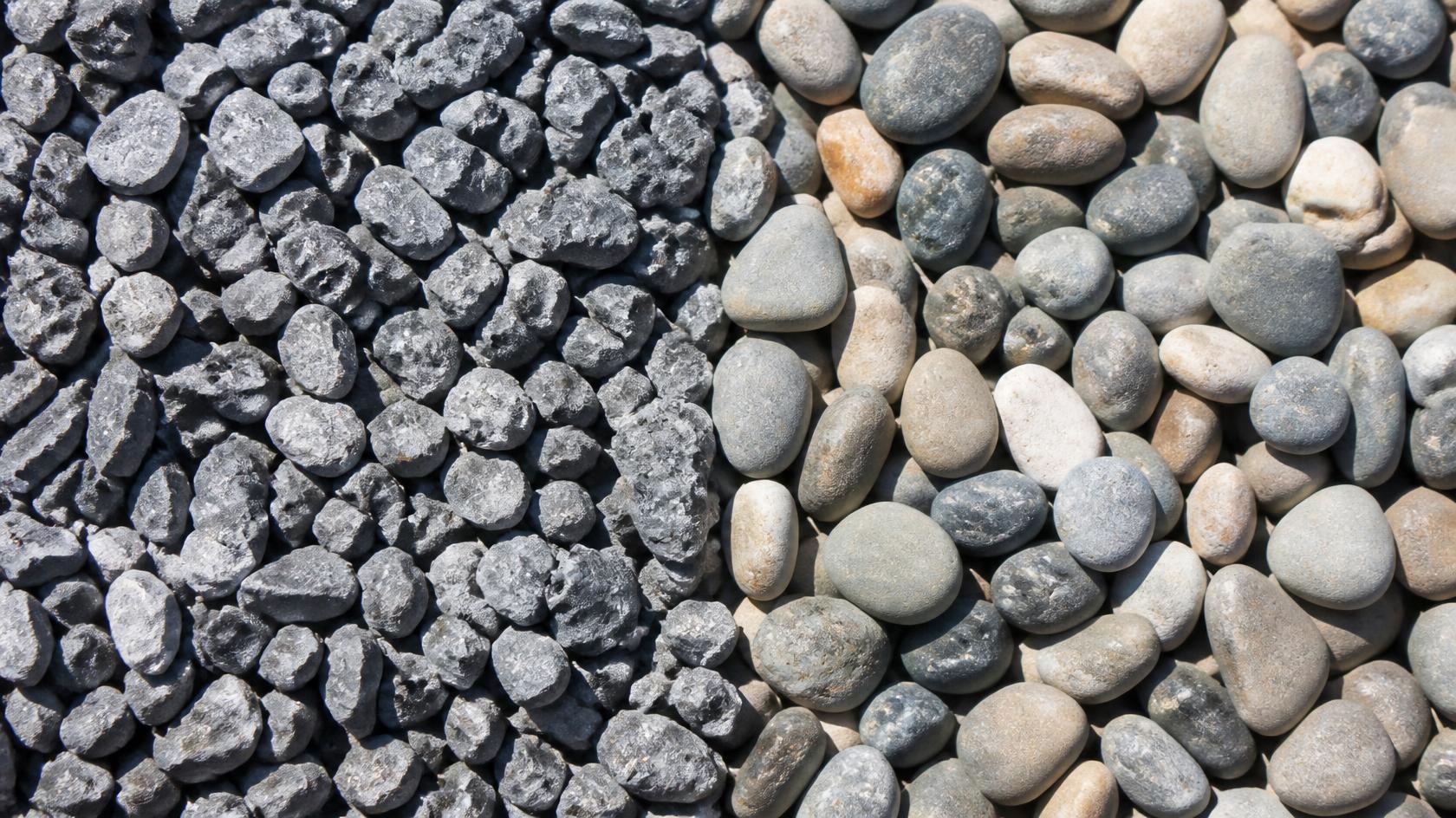
- The trench fill (around the pipe, buried): this rock’s only job is to move water and stay stable. It needs to be angular and washed so it interlocks and keeps large, open gaps called void space that water flows through. Smooth, rounded rock is wrong here.
- The decorative top layer (visible): this rock’s job is to look good and resist washing away. Here, smooth river rock is exactly right it’s attractive, natural, and heavy enough to stay put.
So when people ask “can I use river rock in a French drain?” the honest answer is: yes, as the beautiful top layer but for the fill around the pipe, angular crushed stone drains better and lasts longer. Mixing that up is the single most common reason a good-looking drain quietly stops working underground.
What is the best rock for a French drain?
For the working trench fill, the clear winner is washed, angular crushed stone, 3/4-inch nominal size commonly sold as #57 stone. It succeeds in the large majority of residential French drains for a simple reason: its sharp, irregular edges lock together into a stable structure while maintaining roughly 30 to 40% void space for the life of the installation. That void space is the actual drainage pathway. Here’s how the common options compare:
| Rock type | Use in a French drain? | Why |
|---|---|---|
| 3/4″ washed crushed stone (#57) | BEST trench fill | Angular, interlocks, holds 30–40% void space, won’t compact. |
| 1–1.5″ drain rock | Good for high-volume runs | Larger voids for heavy water; slopes, downspout lines, dry wells. |
| Decorative river rock (1–3″) | YES as the top layer only | Beautiful, washout-resistant finish; too smooth/round for buried fill. |
| Pea gravel | Avoid as fill | Small and smooth compacts, migrates into the pipe, clogs the system. |
| Unwashed / ‘crusher run’ stone | Never | The fines clog the drain immediately one load can ruin it. |
Two rules make all of this work. First, always buy “washed” or “clean” stone never “crusher run” or “dirty” stone, because the fine particles in unwashed rock will clog the drain fast. Second, the stone must be larger than the perforations in your pipe, so it can’t fall in and block it 3/4-inch stone pairs correctly with standard 4-inch perforated pipe.
Why not smooth river rock in the trench?
It comes down to physics. Angular crushed stone has sharp edges that catch and hold when packed, locking into a rigid structure with consistent gaps. Smooth river rock, worn round by water, does the opposite: the stones roll against each other and settle into the tightest possible arrangement, squeezing out the void space that water needs. Less void space means slower drainage, and over time a round-rock trench can compact enough to fail. That’s why every drainage spec points to angular stone for the buried fill and why river rock earns its place on top, not around the pipe.
Want the combo built so it drains for decades and looks great? Get a free drainage assessment or call (913) 829-4949.
How the layered system goes together
Here’s how a French drain topped with river rock is built, layer by layer, so you can see where each rock belongs:
- Trench, sloped at least 1% toward the outlet the slope is non-negotiable.
- Non-woven filter fabric lining the trench, edges left long to fold over later this keeps our clay silt out of the system.
- A few inches of washed 3/4-inch crushed stone as the base.
- The perforated pipe, set on the base, maintaining the slope.
- More washed crushed stone surrounding and covering the pipe the collection zone.
- The filter fabric folded over the top of the crushed stone, sealing it in a permeable envelope.
- A cap of decorative river rock as the visible top layer the dry-creek finish.
That fabric-wrapped crushed-stone core is what makes the system last; the river rock cap is what makes it beautiful. If you want the full build detail on the decorative side, here’s how to install river rock the right way.
How much river rock and crushed stone will you need?
Both layers are sold by the ton or cubic yard, and both are heavy one cubic yard of rock weighs well over a ton. As a rough planning guide, crushed stone and river rock run broadly similar per-yard prices (river rock a bit more for premium/decorative grades), plus delivery. Because a drainage trench uses a fair volume of stone and the material is so heavy to move, this is a project where bulk delivery and machine handling matter hauling several tons of rock by wheelbarrow is exactly the kind of work that ends with half the pile still in the driveway. If budget is a factor, it’s worth understanding what a French drain costs as a complete system before pricing rock alone.
When river rock over a drain isn’t the answer
Honesty matters here, because the combo isn’t right for every situation. A river-rock-topped French drain is ideal where the drain surfaces in the yard and you want it to look good a visible channel, a low route across the lawn, a downspout run. But it’s not a fix for every water problem. If your issue is surface water pooling off a patio, a catch basin may be the better first move. If your yard slopes toward the house, regrading might be the real solution. And if the drain will be buried under sod anyway, you don’t need the decorative rock at all. The right approach depends on diagnosing where your water is actually coming from which is why it’s worth reviewing other yard drainage solutions [/yard-drainage-solutions-johnson-county-ks/] before assuming rock-over-drain is the answer. A good contractor tells you which problem you have first, then picks the fix.
Not sure if this combo is right for your yard? Get a free drainage assessment or call (913) 829-4949 we’ll diagnose the real problem and recommend the right fix.
Why Johnson County homeowners choose MW Lawn & Landscape
A French drain topped with river rock is only as good as the rock choices you can’t see and after 25+ years in Johnson County clay, we get both layers right:
- The right rock in the right layer. Washed angular crushed stone around the pipe so it drains for decades, decorative river rock on top so it looks like a designed feature not the other way around.
- We build for clay. Correct slope, non-woven filter fabric, washed (never dirty) stone, and a real outlet the details that decide whether a drain lasts two years or twenty in our soil.
- Function and curb appeal together. You get a working drainage system and a dry creek bed that improves the property, in one coordinated install.
- One team for the whole job. Drainage, stone, grading, and planting handled together as river rock and drainage installation not bolted on piece by piece.
- Family-owned, licensed, and insured local accountability on work built to last.
Serving Olathe, Overland Park, and Johnson County
MW Lawn & Landscape installs French drains, river rock dry creek beds, and complete drainage solutions across Olathe, Overland Park, and the surrounding Johnson County communities. If you want a drain that actually works and looks like it belongs, we’ll walk your property, find where the water is coming from, and build the combo the right way the working stone underground, the beautiful stone on top the way we have for local homeowners since 2000.
Frequently Asked Questions
What is the best rock for a French drain?
For the buried fill around the pipe, the best rock is washed, angular crushed stone in the 3/4-inch (#57) size range. Its sharp edges interlock into a stable structure that holds 30 to 40% open void space the actual pathway water flows through and it won’t compact over time. For high-volume runs, larger 1 to 1.5-inch drain rock works well. Decorative river rock is best used as the visible top layer, not the trench fill.
Can you use river rock in a French drain?
Yes but for the right layer. Smooth river rock is excellent as the decorative top layer over a French drain, creating an attractive dry-creek-bed look. For the buried fill around the pipe, however, angular crushed stone drains better and lasts longer, because round river rock compacts and loses the void space water needs. So use river rock on top and washed crushed stone around the pipe.
Why is crushed stone better than river rock in a French drain?
Because of shape. Angular crushed stone has sharp edges that lock together and hold consistent gaps (void space) for water to flow through. Smooth, rounded river rock rolls into the tightest arrangement when packed, squeezing out that void space and reducing drainage capacity over time. For the working part of the drain, the interlocking structure of crushed stone is what keeps it draining for decades.
What size gravel is best for a French drain?
3/4-inch (about 19 mm) washed angular stone, commonly #57, is the standard and works in most residential French drains. The general range is 1/2 inch to 1.5 inches: smaller than 1/2 inch compacts and clogs, while 1 to 1.5-inch drain rock suits high-volume situations like steep slopes or downspout lines. The key rule is that the stone must be larger than your pipe’s perforations.
Do I need filter fabric with river rock and a French drain?
Yes, especially in clay soil. A non-woven filter fabric wraps the crushed-stone core to keep fine soil and silt from washing in and clogging the pipe the most common cause of French drain failure. The fabric goes around the working stone layer; the decorative river rock sits on top. Skipping it in Johnson County’s clay can silt up the system within a few seasons.
What rock should you avoid in a French drain?
Avoid pea gravel and any unwashed ‘crusher run’ or ‘dirty’ stone as the trench fill. Pea gravel is small and smooth, so it compacts and can migrate into the pipe and clog it. Unwashed stone contains fine particles that clog the drainage voids almost immediately a single load of dirty stone can ruin the system. Always specify ‘washed’ or ‘clean’ stone for the fill.
Is a French drain with river rock a good idea?
Yes, when the drain surfaces in the yard and you want it to look good. Topping a French drain with decorative river rock creates a dry creek bed that handles storm runoff while looking like an intentional landscape feature. It’s a popular combo in Johnson County because it fixes drainage and improves curb appeal at once as long as the working stone underground is the right angular, washed crushed stone.
How deep should a French drain with river rock be?
The drain itself follows standard depths typically 18 to 24 inches for a yard drain, deeper for foundation work with a continuous slope of at least 1% toward the outlet. The decorative river rock is a cap on top, usually a few inches, over the fabric-wrapped crushed-stone core. Depth is driven by the drainage need, not the decorative layer.