
Trimming shrubs looks simple grab the clippers, cut back what’s too big and that’s exactly why so many shrubs end up as thin, hollow, misshapen versions of what they should be. The truth is that shrubs respond to how you cut, not just how much, and a few wrong cuts can leave a plant weaker and worse-looking for years. The good news: the right technique isn’t complicated once someone shows you the logic. This guide covers the correct tools, the three basic cuts every shrub needs, how to handle flowering shrubs and roses, how to rescue an overgrown shrub, and the mistakes that quietly damage plants all the way from a routine tidy-up to a full rescue. When you’d rather have it done by someone who does it every day, our professional shrub trimming and pruning keeps Olathe shrubs healthy and in shape.
THE SHORT ANSWER
Use the right tool: sharp bypass hand pruners and loppers not hedge shears, except on formal hedges. Make three kinds of cuts: remove the dead/diseased/damaged/crossing branches, thin out whole stems at the base, and head back for shape. Cut correctly: just above an outward-facing bud, at a slight angle, no stubs. Golden rule: prune selectively by hand to keep the shrub’s natural form don’t shear everything into a ball.
Trimming vs pruning: a quick distinction
People use these words interchangeably, but they’re slightly different jobs. Trimming is mostly about appearance shaping shrubs and hedges and cutting back overgrowth for a clean look. Pruning is about health removing dead, diseased, or crossing branches so the plant grows strong. Good shrub care does both at once: you shape for looks and prune for health in the same session. Keeping that dual purpose in mind is what separates real shrub care from just giving a bush a haircut.
Start with the right tools
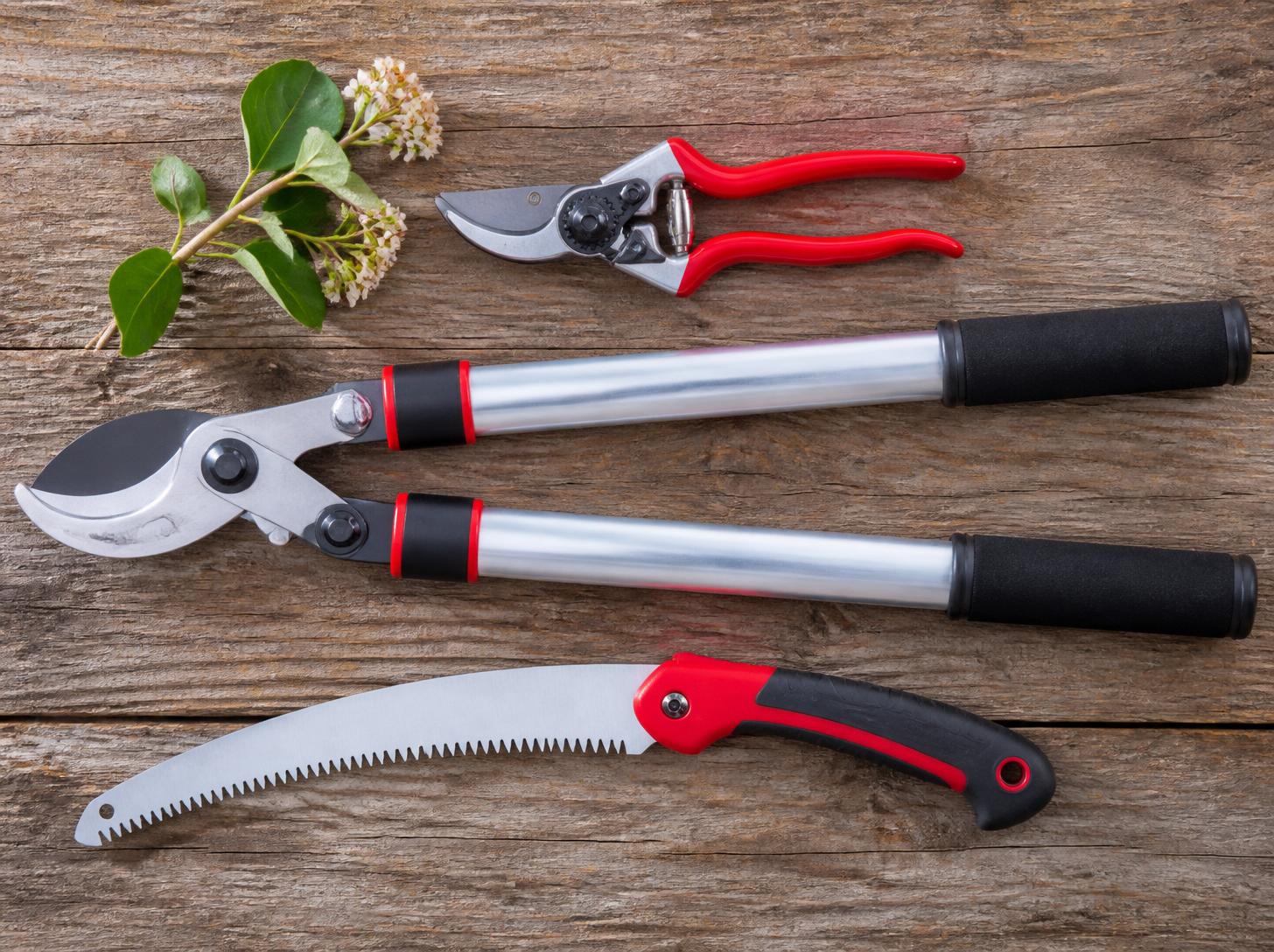
The tool you reach for largely determines whether you’re pruning or mutilating. Here’s what each is for:
| Tool | Use it for | Notes |
|---|---|---|
| Bypass hand pruners | Branches up to ~3/4″ | The workhorse. Bypass (scissor-action) makes clean cuts; avoid anvil types that crush. |
| Loppers | Branches 3/4″–1.5″ | Long handles for leverage and reach into the shrub. |
| Pruning saw | Branches over ~1.5″ | For thick, old wood a lopper can’t handle cleanly. |
| Hedge shears / trimmer | FORMAL hedges only | Great for a clipped hedge wrong for natural-form shrubs (see below). |
Two rules with any tool: keep it sharp (dull blades tear and bruise stems, inviting disease), and disinfect between plants if you’re cutting anything diseased, so you don’t spread it. Clean, sharp cuts heal fast; ragged, crushed ones are open wounds.
How do you properly trim shrubs? The three cuts
Nearly all good shrub work comes down to three kinds of cuts. Learn these and you can trim almost any shrub correctly.
1. Remove the ‘four D’s’ first
Before any shaping, always start by removing the dead, diseased, damaged, and deranged (crossing or rubbing) branches. Cut them back to healthy wood or to the branch’s origin. This alone improves the plant’s health and often opens it up more than you’d expect and it lets you see the true shape before you start shaping. If you spot disease and insect problems on your shrubs while you’re in there, dealing with them is part of good pruning.
2. Thinning cuts (the pro cut)
A thinning cut removes an entire branch back to its point of origin where it joins a larger branch or the main stem. This is the cut professionals rely on, because it reduces size and density while preserving the shrub’s natural shape and letting light into the interior. Thinning keeps a shrub looking full and natural rather than sheared. When in doubt, thin.
3. Heading cuts (for shape and size)
A heading cut shortens a branch by cutting it back to a bud or a smaller side branch, rather than removing it entirely. It’s how you control size and encourage bushier growth. The key is where you cut: always just above an outward-facing bud, so the new growth heads out and away from the plant’s center, keeping it open. Used thoughtfully alongside thinning cuts, heading shapes the shrub; used alone and repeatedly across the whole surface, it becomes shearing which is a different, and usually worse, thing.
How to make a proper cut
The mechanics of the individual cut matter more than people think:
- Cut about a quarter-inch above an outward-facing bud close enough that you don’t leave a dead stub, far enough that you don’t damage the bud.
- Angle the cut slightly (roughly 45 degrees) away from the bud, so water runs off rather than pooling on the bud.
- When removing a whole branch, cut just outside the branch collar the slightly swollen ring where it meets the larger stem never flush, and never leaving a stub. The collar is where the plant seals the wound.
- Never leave stubs. Stubs die back, invite decay, and are the entry point for disease.
Not confident which branches to cut or how much? We shape and prune every shrub type correctly. Schedule professional shrub trimming or call (913) 829-4949.
The biggest mistake: shearing everything into balls
Here’s the single most damaging habit in shrub care, and it’s incredibly common: shearing every shrub into a tight ball or box with a hedge trimmer. K-State’s horticulturists have a name for it “shrub mutilation” and they’re not exaggerating. Repeated shearing creates a dense outer shell of growth that blocks sunlight from reaching the inside of the plant. Over time the interior dies out, and the shrub becomes a thin green skin over a hollow of bare, dead twigs. Once that happens, you often can’t fix it there’s no living growth inside to cut back to.
The correct approach for the vast majority of landscape shrubs is selective hand-pruning thinning and heading individual branches to control size and shape while preserving the plant’s natural form and keeping the interior open to light. Shearing has exactly one legitimate use: genuinely formal hedges, where the tight geometric look is the intended design. For everything else, put the power trimmer down and reach for the hand pruners.
How to trim flowering shrubs (and shrub roses)
Flowering shrubs add one crucial rule to everything above: timing, which determines whether you keep or lose next year’s blooms. The technique is the same the when is what changes.
- Spring-flowering shrubs (lilac, forsythia, azalea, weigela): these bloom on old wood, setting next year’s flower buds the previous summer. Trim them within a few weeks AFTER they finish blooming prune them in winter or early spring and you cut off all the flowers.
- Summer-flowering shrubs (rose of Sharon, panicle hydrangea, spirea): these bloom on new wood, so trim in late winter to early spring before growth starts.
- Shrub roses: remove dead, diseased, and crossing canes first, then shape by cutting canes back to about a quarter-inch above an outward-facing bud at a 45-degree angle the same proper-cut rule, which encourages open, healthy growth and good air circulation. Getting the when to trim each type of shrub right is half the battle with anything that flowers.
How do you trim overgrown shrubs?
An overgrown, woody shrub needs more than a trim but you have to rescue it the right way, and the right way depends entirely on whether it’s deciduous or evergreen.
Deciduous shrubs: rejuvenation or renewal
For badly overgrown deciduous shrubs (lilac, forsythia, spirea, dogwood, privet), you have two options:
- Rejuvenation pruning: cut the entire shrub back to 6-inch stubs in late winter. It looks drastic, but the shrub regrows from the base as a fresh, full plant. Expect reduced or no flowers for a year or two a fair trade for rescuing a plant headed for removal.
- Renewal pruning (gentler): remove about one-third of the oldest, thickest stems at the base each year for three years. The shrub is rejuvenated gradually without ever looking bare the better choice if you can’t stand the drastic look.
Evergreens: the rule you can’t break
Overgrown evergreens (junipers, yews, arborvitae, spruce) are different, and this is the one mistake you cannot undo: never cut an evergreen back into its bare interior the “dead zone” of brown, leafless wood. Most evergreens cannot regrow from bare wood, so every cut must leave green foliage on the branch, or that branch is simply dead for good. This means an overgrown evergreen can only be reduced gradually, staying within its live green growth. If an evergreen has outgrown its space entirely, replacement is often smarter than a butchered rescue an honest conversation worth having before you start cutting.
Got a shrub that’s too far gone to guess on? Schedule professional shrub trimming or call (913) 829-4949 we’ll tell you honestly whether it can be saved.
Aftercare: help them bounce back
Pruning is a stress on the plant, so a little aftercare pays off. Water the shrub well after a significant trim, especially in summer, and clean up all the trimmings so you don’t leave disease or pests sitting in the bed. A healthy, well-fed shrub recovers from pruning far faster than a stressed one which is why deep-root fertilization to keep them strong and good seasonal landscape maintenance make your trimming work last. Never remove more than about a third of a shrub in one session (rejuvenation of deciduous shrubs being the deliberate exception), or you risk shocking the plant.
Why Olathe homeowners choose MW Lawn & Landscape
Good shrub trimming is a skill, and after 25+ years in Johnson County we bring it to every plant on your property:
- Hand-pruning, natural shape. We thin and shape selectively to keep each shrub’s natural form and healthy interior we only shear where a formal hedge is the actual goal.
- We know every plant’s rules. Which shrubs bloom on old wood, where an evergreen’s dead zone is, when each type should be cut so your lilacs still bloom and your junipers survive.
- Health and looks together. We trim for shape and prune for health in the same visit, and flag pests or disease while we’re in there.
- Clean and complete. Every trimming hauled away, the site left tidy no piles left behind.
- Family-owned, licensed, and insured the same skilled crew and standards every visit.
Serving Olathe, Overland Park, and Johnson County
MW Lawn & Landscape provides professional shrub trimming and pruning across Olathe, Overland Park, and the surrounding Johnson County communities from routine shaping to rescuing shrubs that have gotten away from you. We’ll assess each plant, trim it correctly for its type and season, and leave your landscape looking sharp the way we have for local homeowners since 2000.
Frequently Asked Questions
How do you properly trim shrubs?
Start with sharp bypass hand pruners and loppers. First remove the ‘four D’s’ dead, diseased, damaged, and crossing branches. Then use thinning cuts (removing whole branches at their base) to reduce size while keeping the natural shape, and heading cuts (shortening branches to an outward-facing bud) to control size and shape. Cut about a quarter-inch above an outward-facing bud at a slight angle, and never leave stubs. Prune selectively rather than shearing everything into a ball.
How do you trim overgrown shrubs?
It depends on the type. For overgrown deciduous shrubs, you can either rejuvenation-prune cutting the whole shrub back to 6-inch stubs in late winter so it regrows from the base or renewal-prune by removing a third of the oldest stems each year for three years. For evergreens, never cut into the bare interior ‘dead zone,’ because most can’t regrow from bare wood; reduce them only gradually within their green growth.
What tools should I use to trim shrubs?
Sharp bypass hand pruners for branches up to about three-quarters of an inch, loppers for branches up to about an inch and a half, and a pruning saw for anything thicker. Hedge shears or a powered trimmer should be reserved for genuinely formal hedges only using them on natural-form shrubs leads to hollow, damaged plants. Keep tools sharp and disinfect them between diseased plants.
Is it bad to shear shrubs into balls?
Yes, for most shrubs. Repeated shearing creates a dense outer shell that blocks light from the interior, so the inside dies out and the shrub becomes a green shell over bare, dead twigs K-State horticulturists call it ‘shrub mutilation.’ It often can’t be fixed once it happens. Selective hand-pruning that keeps the natural shape is the correct method; shearing belongs only on formal hedges.
How do you trim flowering shrubs?
Use the same cutting technique, but time it by bloom. Spring-flowering shrubs like lilac and forsythia bloom on old wood, so trim them within a few weeks after they finish flowering pruning earlier removes next year’s buds. Summer-flowering shrubs like rose of Sharon and panicle hydrangea bloom on new wood, so trim them in late winter to early spring before growth starts.
How do you trim shrub roses?
First remove dead, diseased, and crossing canes. Then shape the plant by cutting canes back to about a quarter-inch above an outward-facing bud at a 45-degree angle. Cutting to outward-facing buds encourages an open center with good air circulation, which helps prevent disease. This is best done in late winter to early spring for most shrub roses.
Where exactly should I cut when trimming a shrub?
For a heading cut, cut about a quarter-inch above an outward-facing bud, angled slightly away from the bud so water runs off. For removing a whole branch, cut just outside the branch collar the swollen ring where the branch meets the larger stem without leaving a stub and without cutting flush. The collar is where the plant seals the wound, so protecting it matters.
How much of a shrub can I trim at once?
As a rule, never remove more than about one-third of a shrub in a single session, or you risk shocking the plant. The deliberate exception is rejuvenation pruning of overgrown deciduous shrubs, where the whole plant is cut back hard on purpose. For routine trimming, staying under a third keeps the shrub healthy and able to recover quickly.
When is the best time to trim shrubs?
Most shrubs are best trimmed in late winter to early spring, before new growth starts, so cuts heal quickly. The exception is spring-flowering shrubs, which should be trimmed right after they bloom. Dead, diseased, or hazardous branches can be removed any time. Avoid heavy trimming in fall, when the plant can’t seal wounds well before dormancy.