
It’s one of the most common questions we hear from Olathe homeowners planning their beds: should I use river rock or mulch? Both frame a landscape beautifully, both suppress weeds, and both are far better than bare soil but they’re genuinely different materials that suit different jobs, and choosing wrong means either replacing mulch you didn’t want to maintain or living with rock that’s cooking your plants. The honest answer isn’t “rock” or “mulch” it’s knowing which one belongs where. This guide compares them head to head on lifespan, cost, maintenance, and plant health, with special attention to what actually matters in a hot Kansas summer, so you can make the right call for each part of your yard. Whether you land on river rock and stone bed installation or professional mulch installation and bed detailing, we can help you get it right.
THE SHORT ANSWER
Lasts longer: river rock (decades vs. 1–2 years for mulch). Cheaper upfront: mulch. Better for plants: mulch it cools roots and feeds the soil; rock radiates heat. Lower maintenance: rock. The real answer: use rock where water runs and maintenance should be zero, and mulch where plants live. The best Kansas yards use both.
River rock vs. mulch at a glance
Here’s the full head-to-head. Read down the column that matters most to you:
| Factor | River rock | Mulch |
|---|---|---|
| Lifespan | Decades essentially permanent | 1–2 years before it fades and breaks down |
| Upfront cost | Higher | Lower |
| Ongoing cost | None after install | Annual refresh, every year, forever |
| Maintenance | Very low occasional debris blow-out | Yearly top-dressing; edging |
| Soil health | No benefit doesn’t decompose | Enriches soil as it breaks down |
| Root temperature | Absorbs & radiates heat hard on plants | Insulates & cools roots 8–13°F in summer |
| Moisture | Doesn’t hold moisture itself | Cuts evaporation up to ~70% |
| Storm resistance | Stays put in heavy rain | Can float and wash out |
| Weeds | Fewer early; debris builds up over years | Suppresses well when refreshed |
| Removal / change | Difficult & costly it’s permanent | Easy breaks down on its own |
| Best for | Drainage, slopes, splash zones, low-maintenance areas | Planting beds, trees, anywhere plants matter |
What lasts longer: rock or mulch?
Rock, decisively. River rock is stone it doesn’t decompose, so a properly installed rock bed looks and works essentially the same in fifteen years as the day it went in. Mulch is organic and breaks down by design; it fades within a season and needs an annual refresh to keep its color and its weed- and moisture-blocking function. Over a decade, that’s one rock installation versus roughly ten mulch refreshes.
That permanence cuts both ways, though. Rock’s longevity is its biggest selling point and its biggest risk: because it’s so hard and expensive to remove, a rock bed in the wrong place is a mistake you live with for years. Mulch’s short life is actually a feature if you like to change your landscape it’s forgiving, and it disappears on its own. So “lasts longer” is a clear win for rock, but only counts as an advantage where you’re certain you want that permanence.
Which costs less: the real math
This is where a lot of homeowners only look at the sticker and miss the real picture. Rock costs more upfront but nothing after; mulch costs less upfront but forever:
| Cost | River rock | Mulch |
|---|---|---|
| Upfront (installed) | Higher material + heavy labor | Lower roughly $70–$130 per cubic yard installed |
| Year 2 onward | ~$0 | Annual refresh, ~$200–$600+ per year for typical beds |
| 10-year total | One install | One install + ~9 refreshes |
| Break-even | Rock usually pays back in ~7–10 years | Cheaper only in the short term |
The takeaway: if you’ll keep the bed the same for a decade or more, rock often wins on total cost despite the higher start. If you like to refresh your look, are on a tighter upfront budget, or the bed is full of plants that need mulch’s benefits anyway, mulch is the smarter spend. If you want to dig into the numbers, here’s what mulch installation costs in detail.
Want a straight recommendation for your specific beds? Get a free landscaping quote or call (913) 829-4949 we’ll tell you which belongs where.
The Kansas factor: heat and your plants
Here’s the consideration that matters more in Kansas than almost anywhere, and the one generic comparisons skip: heat. River rock absorbs the sun’s heat all day and radiates it back a rock bed against a south- or west-facing wall in a Kansas July becomes a genuine oven, baking the roots of anything planted in it and pushing warmth back toward your house. Mulch does the opposite: a 2–3 inch layer cools the soil by 8 to 13 degrees and holds moisture, cutting evaporation by up to 70% right when your plants need it most.
This is the single biggest reason the “rock everywhere” look backfires here. For beds full of perennials, shrubs, or anything you want to thrive, mulch is simply better for the plants it keeps roots cool, holds water, and feeds the soil as it breaks down. Rock is for places where plant health isn’t the priority. That’s the whole logic of choosing by location rather than picking one material for the entire yard. The the full benefits of mulching go well beyond appearance for exactly this reason.
When to choose river rock
Rock is the right call when permanence and low maintenance matter more than plant vitality:
- Drainage areas and dry creek beds rock channels water without washing away, and pairs naturally with drainage work.
- Downspout splash zones the spot mulch always floats out of.
- Slopes and erosion-prone areas rock holds where mulch slides.
- Tight side yards, around AC units, utility areas low-traffic zones you never want to maintain.
- Modern, architectural, or xeriscape designs where the clean permanent look is the goal.
- Around established, heat-tolerant plants not tender ones.
When to choose mulch
Mulch wins wherever plants are the point:
- Flower beds, perennial borders, and vegetable gardens anything that benefits from cool roots and moisture.
- Around trees and shrubs mulch feeds the soil and protects roots (kept off the trunk, never a ‘volcano’).
- New plantings that need help establishing.
- Beds you may want to redesign in a few years mulch is forgiving and easy to change.
- Anywhere you want to improve the soil over time, since organic mulch breaks down into nutrients.
The pro answer: use both
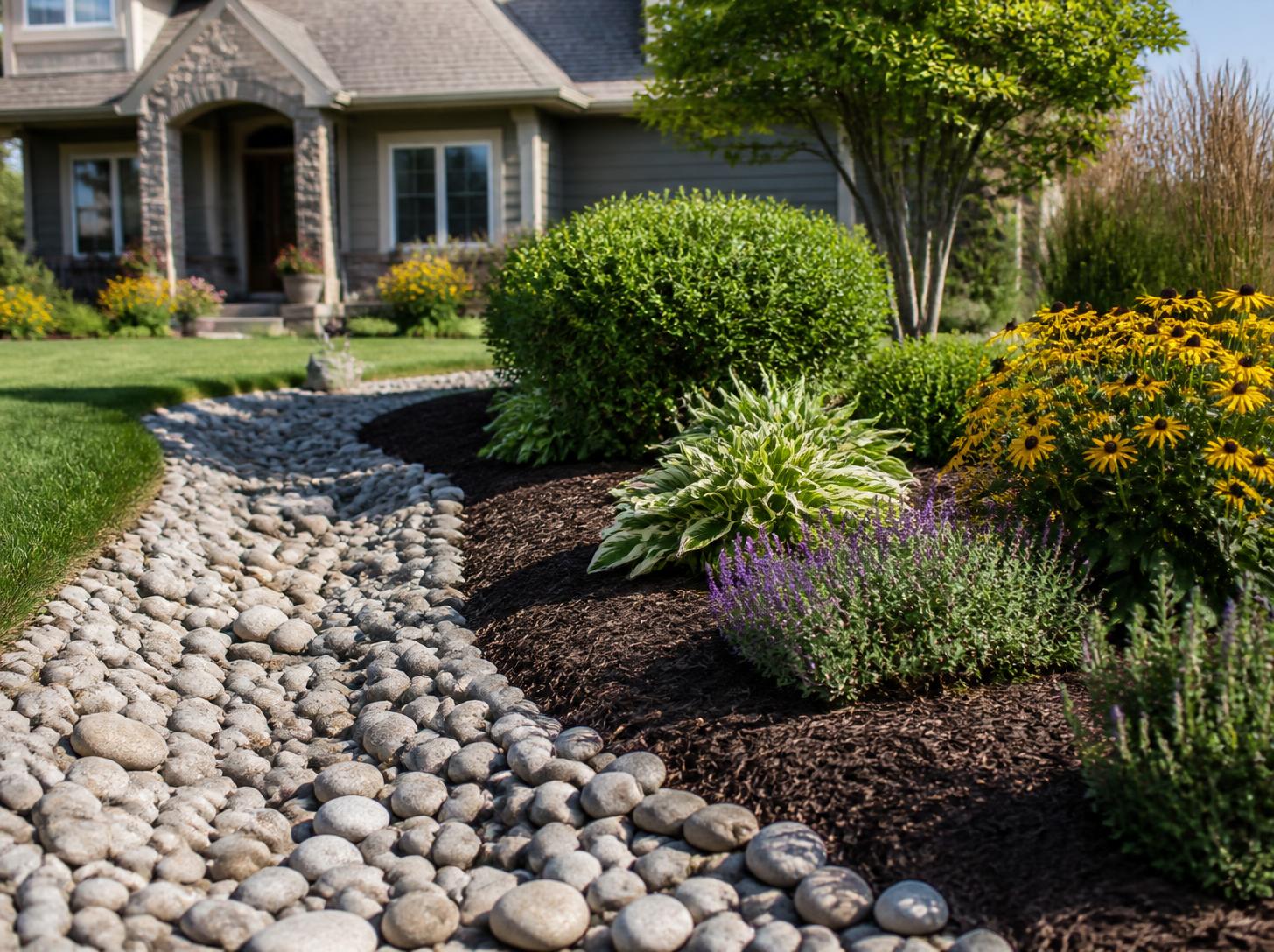
Ask a landscaper who isn’t trying to sell you one product, and the real answer is almost always “both, in the right places.” The best Kansas yards use rock and mulch strategically: river rock in the drainage paths, splash zones, slopes, and low-maintenance corners where it shines, and mulch in the planting beds and around trees where cool roots and healthy soil matter. Done well, the rock reads as intentional structure and the mulch keeps your plants thriving and a crisp edge between them makes the whole property look designed rather than defaulted.
This is exactly the kind of decision professional mulch installation and bed detailing and river rock and stone bed installation are meant to sort out together matching each material to each part of your yard, instead of committing the whole property to one.
A note on installation both need it done right
Whichever you choose, the invisible work decides whether you’re happy in five years. Rock needs proper excavation, steel edging, and woven fabric for separation (so stone doesn’t sink into our clay) there’s a right way to how to install river rock the right way [/how-to-install-river-rock-landscaping/]. Mulch needs correct 2–3 inch depth, kept off trunks, over cleanly edged beds. Both are unforgiving of shortcuts: rock mistakes are permanent and heavy to fix, and over-piled mulch can rot your plants. Done properly, either one elevates a property; done carelessly, either one becomes a maintenance headache.
Rock, mulch, or the right mix of both? Get a free landscaping quote or call (913) 829-4949 we’ll design it for your yard and your budget.
Why Olathe homeowners choose MW Lawn & Landscape
Choosing between rock and mulch is really a design decision, and after 25+ years in Johnson County we make it for your yard, not from a script:
- We recommend by location, not by what we’d rather sell. Rock where it belongs, mulch where plants live often both on the same property.
- We install both correctly. Excavation, edging, and fabric for rock; correct depth and trunk clearance for mulch the details that decide the result.
- We know Kansas heat and clay. We won’t put rock where it’ll bake your plants, or mulch where it’ll wash away we match the material to the conditions.
- One team for the whole yard. From river rock and stone bed installation to professional mulch installation and bed detailing, it’s one coordinated plan.
- Family-owned, licensed, and insured local accountability on work built to last.
Serving Olathe, Overland Park, and Johnson County
MW Lawn & Landscape installs river rock, stone beds, and mulch across Olathe, Overland Park, and the surrounding Johnson County communities. Not sure which is right for your beds? We’ll walk your property, factor in sun, slope, drainage, and your plants, and recommend the mix that looks best and lasts longest the way we have for local homeowners since 2000.
Frequently Asked Questions
Is river rock better than mulch?
Neither is universally better they suit different jobs. River rock is better for permanence, low maintenance, drainage areas, slopes, and splash zones. Mulch is better for plant health, because it cools roots, holds moisture, and enriches the soil as it breaks down. In a hot Kansas climate, rock can bake plants, so mulch is usually better in planting beds. The best yards use both, matched to each area.
What lasts longer, rock or mulch?
River rock lasts far longer it’s stone, so it doesn’t decompose and can last decades essentially unchanged. Mulch is organic and breaks down by design, fading within a season and needing an annual refresh. Over ten years, that’s one rock installation versus roughly ten mulch refreshes. The trade-off is that rock is permanent and costly to remove, while mulch is easy to change.
Is river rock or mulch cheaper?
Mulch is cheaper upfront about $70 to $130 per cubic yard installed while river rock costs more to install. But mulch needs replacing every year or two, so over a decade rock often costs less in total. Rock typically breaks even against repeated mulch refreshes in about seven to ten years. Mulch wins on short-term and flexible budgets; rock wins on long-term cost if the bed stays the same.
Is river rock bad for plants in Kansas?
It can be. River rock absorbs and radiates heat, so a rock bed in full Kansas sun especially against a south- or west-facing wall raises soil temperature and can stress or bake plant roots. It also doesn’t hold moisture or feed the soil. For beds full of perennials, shrubs, or tender plants, mulch is usually the better choice; rock is best reserved for low-plant, low-maintenance, or drainage areas.
Can I use both river rock and mulch?
Yes and it’s usually the best approach. Use river rock in drainage paths, splash zones, slopes, and low-maintenance corners where permanence matters, and mulch in planting beds and around trees where cool roots and healthy soil matter. A clean edge between the two makes the property look intentionally designed. Most well-designed Kansas landscapes use a strategic mix rather than one material everywhere.
Does river rock stop weeds better than mulch?
Rock suppresses weeds well at first and, being permanent, doesn’t need refreshing to keep doing so. But over the years, debris collects between the stones and forms a thin soil layer where weeds germinate. Mulch suppresses weeds effectively too but must be refreshed annually to stay effective. Neither is fully weed-proof; both work best over a proper landscape fabric or with regular upkeep.
Which is lower maintenance, rock or mulch?
River rock is lower maintenance day to day no annual refresh, just occasional debris blow-out and spot weeding. Mulch needs a yearly top-dressing and re-edging to stay fresh and functional. If minimal upkeep is your top priority and the area doesn’t need plant-friendly conditions, rock is the lower-maintenance choice.
Should I replace my mulch with river rock?
It depends on the bed. Converting to rock makes sense for low-plant, low-maintenance, or drainage-prone areas where you want a permanent, tidy look. It’s not a good idea in beds full of plants that benefit from mulch’s cooling and soil enrichment, especially in hot, sunny Kansas spots. A professional can tell you which of your beds are good candidates and which should stay mulched.